Introducing Common Assessment in the Classroom
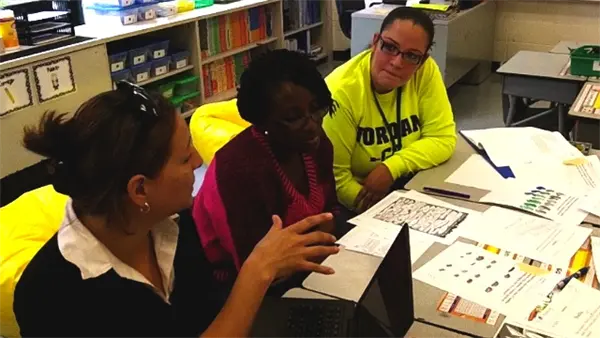
Throughout the year, Innovations sister schools have been discussing different ways to make teaching a more collaborative process between teachers. Lesson study, for example, invites educators to come together to spectate, discuss, and refine a single math lesson. Common assessment is another strategy that, through the collaborative review of student work, has resulted in increased understanding among math teachers. Earlier this year, several Innovations teachers from Jordan Elementary took part in a meeting to explore common assessment.
For this meeting, teachers brought in samples of student work from a problem they all recently gave to their students. The problem: “Daniel has a basket. There are 17 socks in the basket. How many pairs of socks are in the basket?” The student work they reviewed included examples from struggling students as well as those who displayed a firmer grasp of the material.
Daniel has a basket. There are 17 socks in the basket. How many pairs of socks are in the basket?
The teachers were given time to study the work of each other’s students, taking notes as they went. A discussion then took place among the teachers over what they noticed about the work and how it appeared the students were thinking about the given problem. For example, while looking at an example that had drawings of socks with circles around groups of two, first grade teacher Gladys Paredes commented, “I noticed that the student can use pictures to represent quantity.” Innovations coach Donna Johnson said, “I saw that they understood that the term ‘pair’ meant ‘two.’”
The discussion then shifted to determine what it appeared the student did or did not understand about the math in the problem. For this, they used the Landscape of Learning (pdf) as a common base of understanding. Finally, the teachers were given a chance to pose questions about anything that remained unclear about the work or the problem itself. The teacher whose students’ work was being discussed then had an opportunity to respond to the observations made and to answer whatever questions remained.
Afterwards all in attendance performed the most crucial step, which was to connect the points made during the discussion to create some overall suggestions for future success in the classroom. In this particular meeting, it became clear that some students had difficulty working with numbers “in context.” The teachers decided that continued work with word problems and number stories was needed. They also found that many students, even those who were reaching the correct answer, were struggling to explain how they came to their solution. Activities that promote students’ articulation of their math thinking, such as Math Talks, for example, might help remedy this.
Like many collaborative tools used to strengthen teaching practices, looking together at student work using common assessment is a great way for teachers to get feedback about the effectiveness of their teaching practices based on evidence of students’ learning. “Not only were [the other teachers] able to see what I did not see, but they gave great suggestions that I would have never thought of,” reflects first grade teacher Miliany Rivera. “I encourage that more of these type of small group settings are done amongst colleagues… they can help teachers take their students to a higher level of thinking.”



Support our work
The Early Math Collaborative works to improve math instruction for young children in three ways:
- Professional development
- Research
- Dissemination