Lesson Study Experiences Spread Through Innovations Schools
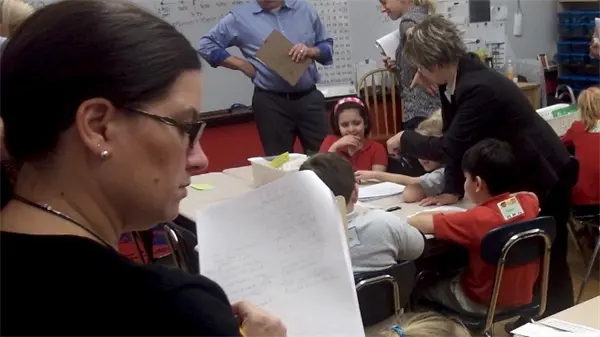
In November public lessons took place at two Innovations schools: a first-grade lesson took place at Gale Elementary in Rogers Park and a third-grade lesson took place at Reinberg Elementary in Portage Park. The lessons, part of a broader lesson study process, were open not only to faculty members of the schools, but also to teachers from other Chicago Public Schools and administrators from the CPS Office of Math and Science. Tom McDougal from the Lesson Study Alliance helped facilitate these events.
Lesson study is a process designed by Japanese educators as a means to examine and improve teaching practices. From start to finish, it is a collaborative process. First, teachers work together to design a new lesson plan. Once written, one member of the group teaches the lesson to her or his own classroom of students. While the lesson is going on, the other teachers and educators in the lesson study group observe and take notes on the students’ performance. Teaching to a familiar group of students eliminates the variable of unfamiliarity and allows the group to see how the lesson would function in an actual classroom environment. After the lesson concludes, the core of the lesson study process takes place among all of the educators in attendance, as they focus on the evidence of student work collected by the observers during the lesson and discuss whether the students were able to reach the intended goals set forth earlier.
Since we at the Collaborative only have one more year at our Innovations schools, we have been very conscious of how to establish systems that will allow for continual improvement in math instruction once we move on from the schools. Teacher-led professional development is a method we are trying to establish, and lesson study is a powerful vehicle for this. – Rebeca Itzkowich, Instructor
The lesson study featured word problems centering on topics that are frequently difficult for students to grasp and similarly difficult for teachers to explain. The first grade lesson dealt with breaking up addends to simplify daunting addition problems. The third grade lesson dealt with computing elapsed time crossing an hour. In both cases, while reaching the correct answer was the main objective of the problem, the lesson study teams were attempting to foster the development of broader problem-solving strategies in the students.
The team at Gale was comprised of first-grade teacher Kim Haynes and third-grade teachers Danielle Washington and Lanetta Wilson. The team at Reinberg was comprised of special education teacher Jennifer Gunn, first-grade teacher Julie Huynh, and third-grade teacher Margaret Wegrzyn.
During the summer, teams from four Innovations schools attended a four-day long summer institute in lesson study where they learned about teaching through problem-solving. The two other schools that took part in this, Brentano Math and Science Academy and Lorca Elementary, are considering hosting lesson study events later this year. Administrators from the four other Innovations schools have expressed interest in the method after seeing the results from Gale and Reinberg.
Lesson study is opening up a number of possibilities for transforming the culture of teachers within the school. By making teaching public, the Collaborative is beginning to undermine the assumption that teaching is a private event between a teacher and students. In addition, by discussing the effects on student learning that result from the team’s lesson, teachers and administrators can begin to see more clearly the connection between teaching and learning. Once a school incorporates these practices on a regular basis, our teachers will have more opportunities to expand and improve their teaching abilities.



Support our work
The Early Math Collaborative works to improve math instruction for young children in three ways:
- Professional development
- Research
- Dissemination