Permission to Stay Small: Why We Need to Focus on 1-10
By Jennifer McCray
Learning to count is such a feat! As teachers and parents, when we hear a young child reciting the counting words in order, we cannot help but praise the effort; it is such clear evidence of learning. And truly, being able to say this string of words in order, whether up to 10 or up to 20 or beyond, is a real accomplishment, and one that supports other important math learning as well.
The problem comes in when we stress this recitation of words beyond all other kinds of number-related activities. Often when adults learn that I study math education, they tell me “how high” their preschooler can count as evidence that their child is good at math. And it is true that when young children have learned the decade pattern – “twenty-eight, twenty-nine…thirty…thirty-eight, thirty-nine, forty” they have begun to understand an important structural piece of our number system. There is no harm in this, and it can certainly be an advantage in learning, but there is much more to be understood about how numbers work at a very basic level, and small numbers are a better tool for that learning.
Cardinality

Let’s start with cardinal understanding. Number words are tricky, in part, because of how we use them. Each number word has a sort of dual nature that we do not find in other kinds of words. That is, each is used to tag an item as we count a set, but each can also mean a total amount. Five is the number we say after four and before six, but it is also the amount of fingers on our right hand or maybe the number of people in our family.
There often is a stage in learning to count when young children respond to a “how many?” question by saying the count sequence aloud, but do not seem to understand that counting is used to tell how many. That is, we ask Bruno, “how many pencils?” and he says, “one, two, three, four, five.” We say, “so how many pencils is that all together?” and Bruno repeats “one, two, three, four, five.”
This is an important stage in counting development and represents a lot of learning. Bruno knows that counting things is the right response when someone asks “how many.” He knows how to use the counting words in the correct order, and he may even be doing a good job of keeping track of which pencils he has counted. But the tricky part is that last word… “five.” To tell us how many pencils, Bruno needs to use “five” in two ways – first as a tag for making sure he counts all the pencils, and then as a way to describe the total amount. First, the word is focused on only one pencil, then suddenly it means all of them? This is a strange talking/thinking move, and one that he has never encountered with other words and ideas.
Of course, most children eventually do get this idea, that each of the counting words is part of a tagging system but also means a total amount, but it takes time. One of the best ways for children to see and understand this is with small numbers. Humans have innate abilities to subitize, or “see” very small amounts without counting them. That is, we can glance at three apples, and without counting them, we can know that there are three. With seven or eight apples, we are likely to need to actively count them to be sure of the amount.
For this reason, very small numbers help children bring the two functions of each number word together. Because Janice can see there are three cookies on the plate, when she then uses her burgeoning counting skills on the cookies, “one, two, three,” she has all the evidence she needs to see how that sneaky last word works. Children benefit from having a lot of experiences subitizing small sets alongside counting.
Composition
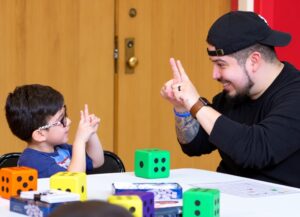
Another sophisticated idea about how numbers work is that each number is made up of other numbers. That is, four can be thought of as two and two, or it can be thought of as three and one. Or we can focus on the “four-ness” of four itself, like thinking about the four-face on a die.
This quality of amounts inside of other amounts is something that runs throughout our infinite number system. It makes numbers extremely flexible and powerful, and understanding it makes sense of the ideas of addition and subtraction—two of the most basic and important operations we humans commonly use.
Like cardinality, composition is an idea that is more easily conceived when the amounts we are managing are small ones. That is, it is much easier to “see” the two and two inside of four than it is to see the seventeen and five inside of twenty-three. Giving children lots of opportunities to build this understanding by working with small amounts is like providing handholds or scaffolding. Children get good at thinking about how these things are possible when they are working with amounts they can mentally understand.
As a teacher or a parent, it is sometimes hard to recall just how abstract and—frankly, weird—some of these rules about how numbers work truly are. Hearing a child recite counting words up to one hundred feels so exciting—it is such a clear demonstration of at least one kind of mastery. And there is nothing wrong with celebrating it. However, it is also important that we do not let that kind of exciting accomplishment distract us from the very real, complex, and important number sense ideas that children can build when they have lots of time with small numbers. In preschool, and even kindergarten, the numbers under ten are an important arena for developing durable ideas about how numbers relate to one another and why counting works.
General recommendations for deeply exploring number relationships allow children to build a strong number sense foundation through the early grades:
- Preschool: 1-5
- Kindergarten: 1-10
- 1st grade: 1-20
- 2nd grade: 1-100
Explore resources from the Early Math Collaborative to bring small numbers to life at home and in your learning environment.



Support our work
The Early Math Collaborative works to improve math instruction for young children in three ways:
- Professional development
- Research
- Dissemination