New Math Experiences Developing at Lorca Elementary
In the last edition of the Innovations project newsletter, we highlighted the work of a few newcomers: Marybel Cortes, Nicole Sandoval, and Brittany Williams at Brentano Math and Science Academy. We would like to continue this discussion by focusing on the work of two other new teachers in our project: first grade teacher Hilda Castro and second grade teacher Carmen Mojica, both at Lorca Elementary.
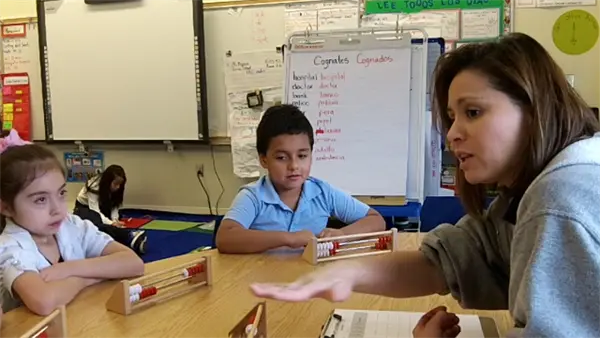
Castro and Mojica both have been using the rekenrek counting rack as an essential tool for math instruction in their classrooms. Discussion has also become central to their math lessons. Earlier this year, Castro led a mini-lesson from a math investigation unit some Innovations veterans might be familiar with: the Double Decker Bus. In this mini-lesson, students are distributed individual rekenreks, with the beads representing passengers riding a double decker bus. Given a number of riders, students decide how many people are sitting on the upper- and lower-levels of the bus and represent that quantity on their rekenreks. The different combinations of addends that make up the same quantity of passengers, as well as the various counting strategies that students utilize, allow for long, productive conversations that help young students develop big mathematical ideas about compensation, equivalence and conservation.
Teachers can also reinforce these ideas outside of formal math lessons. Mojica, for instance, turns the daily routine of taking attendance into a mini-math exercise by using a rekenrek-inspired attendance chart. When children enter the classroom for the day, they put slips of paper in the red- and white-colored pockets on the chart. Once everyone has done this, she prompts her students to tell her how many students are in attendance. At the beginning of the year, most students counted by ones to come to the solution. Now students are starting to make use of the mathematical structure of the rekenrek to answer the question more quickly. By strategically moving individual slips into empty slots on the rekenrek chart, they can see quantities more easily without counting. It has been encouraging to hear students make statements such as, “If an entire row is filled we don’t need to count. I know it is ten.



Support our work
The Early Math Collaborative works to improve math instruction for young children in three ways:
- Professional development
- Research
- Dissemination