
Commentary: From Head Start’s beginning, Erikson Institute helped build trust in it
A child’s day of learning and a parent’s day of work often begin at a doorway where they say their goodbyes.
Before becoming president of Erikson Institute, I taught public preschool, but I still see early childhood through that doorway: children arriving with questions, parents entrusting educators with their precious ones.
Chicago helped build that trust. In 1966, educator and activist Barbara Taylor Bowman, child psychologist Maria Piers, social worker Lorraine Wallach and Irving B. Harris founded the Erikson Institute to prepare professionals in the recently started Head Start program.
Nearly six decades later, the National Head Start Association’s 2025 Illinois profile reports 28,397 funded seats across Head Start programs and 18,958 parents employed, in school or in job training—connecting children’s early education with families’ working lives.
Enrollment tells only part of the story. Research traces Head Start’s effects beyond the preschool years, including increased high school completion by 2.7% and college completion by 39%, alongside improvements in economic self-sufficiency in adulthood.
Now, the Trump administration is proposing to replace detailed federal standards with a framework that emphasizes local flexibility. The Department of Health and Human Services (HHS) says fewer requirements could expand enrollment within existing budgets. For Chicago families, the issue is not simply how many children can fit into a classroom, but whether each child will receive the attention, responsive teaching, and care they deserve.
A recent collaboration between Head Start and Chicago Public Schools offers a warning: bringing services into classrooms still requires adequate staffing and coordination. CPS specialists delivered special education services in six Head Start classrooms, eliminating children’s midday bus trips to separate locations. Despite notable benefits, specialist shortages and insufficient time to plan and coordinate compromised the quality of care.
The HHS proposal would remove service-duration requirements, although statutory minimums would remain. A preschool seat ending at noon cannot cover a parent’s an eight-hour shift and commute. Shorter schedules may lead to additional childcare expenses or lost work time. Where hours shrink, savings in a program’s budget could cost a family’s financial and mental well-being.
The proposal also would require instruction in English, with an exception for tribal programs. Consider a young child who can explain an idea in Spanish but not (yet) in English. English-only instruction would constrain how a teacher engages the child.
At Erikson, we know children do not develop in pieces. We prepare teachers to attend to development and education across languages, abilities and developmental trajectories. Children’s languages connect learning with relationships, memories and ways of making meaning. Understanding a child includes understanding those connections.
Classroom staffing matters, too. The HHS proposal would defer to applicable state and local requirements. HHS acknowledges that removing federal group-size and staffing-ratio requirements could mean less individual attention.
For children needing intervention, timing matters. Proposed changes would eliminate the requirement that every child receive health, vision, hearing and developmental screenings within 45 or 90 days of enrollment — potentially allowing programs to comply with the law without systematically screening most children. Screening is not a diagnosis. It can identify concerns requiring evaluation. HHS says statutory screening obligations remain.
Illinois has services to connect children with early intervention for eligible children under 3 and Chicago Public Schools special education for eligible children ages 3-5. And, while the federal mandate Child Find offers resources and identifies services families can access, a service’s existence does not ensure a child reaches it. Delayed screening or referral may leave needs unidentified and postpone support. The Centers for Disease Control and Prevention emphasize that early identification and intervention are essential to child development.
For a child needing early intervention, a delay can mean time spent learning without support an evaluation could identify. For parents, follow-through can mean navigating appointments, transportation and work schedules. An enrollment count captures none of that.
When I picture Chicago’s future, I return to the doorway where parent and child start their day. Families need hours that permit work, language that fosters participation, and follow-through that connects a concern to care. Enrollment tells us who came through the door. It does not tell us what they found on the other side.
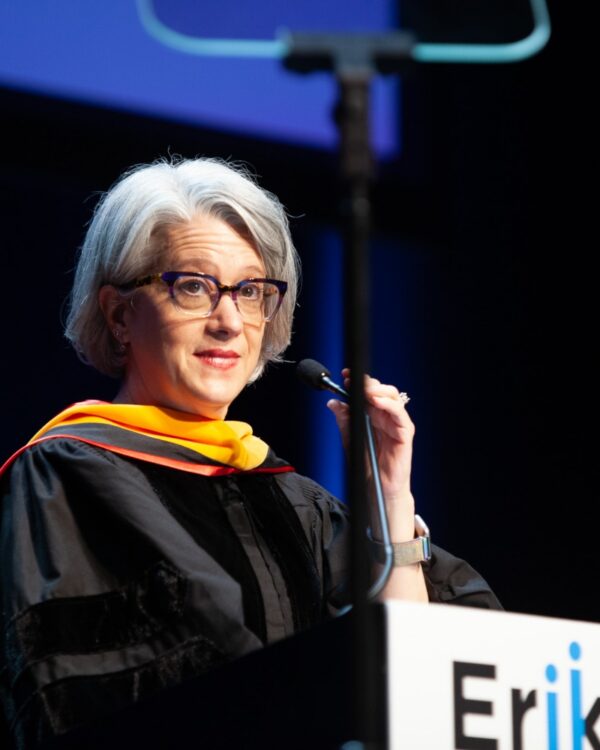
Mariana Souto-Manning is President of Erikson Institute.

Join the Erikson family with monthly news + events updates shared by academics, community members, and families.



Create a Better Future For Children While Building Yours
Embark on your early childhood graduate program path at Erikson Institute and start changing lives.