
FAN training
Facilitating Attuned Interactions (FAN)
Learn Erikson Institute’s evidence-informed approach to strengthening relationships between professionals and the children and families they serve.
You Can Build Better Relationships with Parents
Partner with Erikson to learn the Facilitating Attuned Interactions approach. FAN’s ultimate goal is strengthening the provider-parent relationship, resulting in parents who are attuned to their infants and ready to try new ways of relating to them.
FAN training helps early childhood, health care, mental health, social work, home visiting, early intervention and other family-serving professionals build skills, respond empathetically, and strengthen engagement with families. FAN also helps providers feel more effective, less stressed, and more satisfied in their roles.


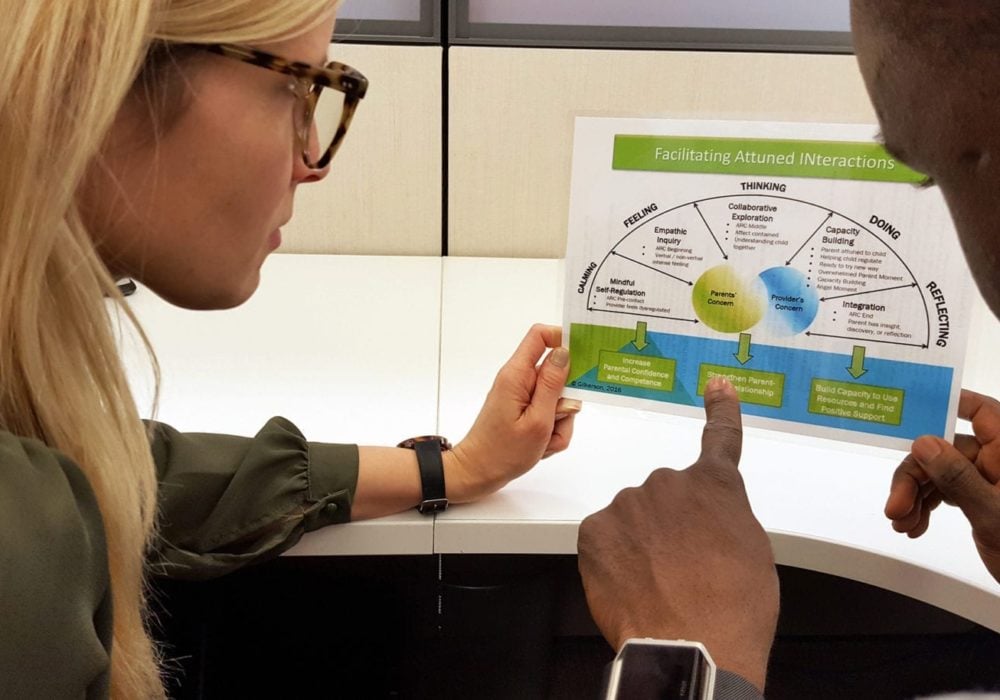
FAN Tools
A Practical Framework for Navigating Family Interactions
We are a training program that believes people need to feel connected and understood in order to be open to change. Erikson Institute’s FAN tool ensures practitioners read cues from parents and themselves and thus, provide empathetic and appropriate responses. Through FAN training, practitioners learn strategies designed to help them:
- Strengthen relationships and engagement with families
- Recognize and respond to parent and caregiver cues
- Communicate with greater empathy and intention
- Build reflective capacity
- Remain centered during challenging interactions
- Collaborate more effectively with parents and caregivers
FAN by the Numbers
See how the FAN approach is improving outcomes for children and families.
What to Expect from Your FAN Training
Who is the FAN approach for?
- Programs and systems that seek to promote parent engagement and build staff reflective capacity
- Home visitation programs
- Center-based infant and early childhood programs
- Early intervention Part C programs
- Infant and early childhood mental health services including consultation
- Pediatric residency training, primary care pediatrics, and NICU staff
- Child welfare agencies
- Other social work and early childhood professionals
- Youth mentoring programs (in collaboration with Loyola University)
Types of FAN Training Offered
Training For Programs
- Introductory Training (1 Day): A one-day introduction to the FAN approach, core concepts, and relationship-based practices.
- FAN CORE Training: A months-long learning experience that combines initial training with reflective practice, mentoring or booster sessions, and support.
- Level I: Training for supervisors and staff (typically 2 days)
- Level II Reflective Practice: Booster trainings and/or mentoring during 6-9 months
- Final Day of Training for Integration and Sustainability Planning
Train-The-Trainer
Erikson works with state systems, larger programs, and academic institutions to prepare their professional development staff members to become FAN trainers.
FAN training is aligned with the Alliance for the Advancement of Infant Mental Health’s Endorsement for Culturally Sensitive, Relationship-based Practice Promoting Infant Mental Health®.
Research & Evidence Behind the FAN Method
FAN has been evaluated in professional practice settings by researchers and academic partners including Chapin Hall at the University of Chicago, Loyola University, and the University of Illinois at Chicago.
Home Visiting & Supervision
Evaluations found that practitioners using FAN focused more on parenting, were more reflective and collaborative, and reported less burnout. Supervisors demonstrated greater self-awareness, asked more questions, and provided more reflective supervision.
Pediatric Care
Research conducted by Erikson Institute with the University of Illinois at Chicago found that pediatric residents using FAN reported greater empathy and mindfulness, along with increased satisfaction with their communication with families.
Frequently Asked Questions
Facilitating Attuned Interactions was developed at Erikson Institute and originated through Erikson’s Fussy Baby Network. Linda Gilkerson, PhD, founder of the FAN approach, developed the model from Erikson’s relationship-based work with infants, families, and professionals.
Facilitating Attuned Interactions (FAN) is an Erikson Institute-developed relationship-based training approach that helps family-serving professionals strengthen engagement, empathy, reflective practice, and communication with children and families.
FAN is used in a range of family-serving settings, including home visiting programs, early childhood centers, early intervention programs, infant and early childhood mental health services, and more.
FAN training varies by format. Erikson offers a one-day introductory training, while FAN CORE Training typically begins with two days of Level I training followed by six to nine months of reflective practice, booster training or mentoring, and a final training day focused on integration and sustainability.
Erikson Institute is a graduate institution specializing in child development, early childhood education, and social work. Through education, research, professional learning, and community-based work, Erikson helps professionals strengthen outcomes for young children and families. Facilitating Attuned Interactions (FAN) is a relationship-based approach developed at Erikson Institute.

Help Us Change the World for Children
Join the Erikson Institute community and discover the difference one person can make.