In the real world we usually don’t count by ones, beginning with one. It takes too long. We find ways of getting to a number much faster. We may begin at a higher number we know and count on or count back. For example, you have groups of 10 stacks of plates, and you need 12, so you’ll just take a stack and add 11, 12 and now you have 12 plates. Or you take 3 plates from the stack and count down–10, 9, 8–to keep track of how many plates are left.
These faster ways of counting work because of a rule for rational counting, the stable order rule. This rule states that the order of numbers is a fixed pattern, with each number representing a quantity that is always one more than the number that precedes it and one less than the number that comes after it. So put in another way, 4 is one more than 3 and 3 is one less than 4.
Children need experiences and practice counting in different, flexible ways while learning these rules of counting. And what better way to do that than through the books they love to hear over and over.
Counting with fingerplays such as the classic Five Little Monkeys Jumping on the Bed provides kids the opportunity to see, hear, and act out counting in different ways. From keeping track of the monkeys on the bed with fingers to the joy of pretending to jump on the bed and fall off, children can model the one-less pattern of counting down. And, you can extend their learning by asking all kinds of questions that touch on the rules of counting.
What if 2 more monkeys came over to play with the 5 little monkeys? Can we count down if they also started jumping on the bed?
What if 2 monkeys fell off at once?
Editor’s Note: This particular song may have a racist history, and it is racist to compare any group of humans with monkeys. However, given the ubiquity of this song and book in early childhood classrooms, we feel that it’s worth thinking about how to mathematize the inherent counting-down pattern. For other fingerplay ideas, please see our list of favorite nature-inspired fingerplays and songs below.
A favorite book, The Doorbell Rang by Pat Hutchins, also provides an engaging context for counting. In this book, Ma’s cookies become irresistible to her family and friends. As guests come to partake, the cookies continually disappear into hungry bellies. It’s a relatable and well-told story for young children, and it introduces some ideas that can be explored along the way. Just change it to pizza!
Your family is sharing pizza. Into how many pieces should it be cut?
Decide on 2 different pizzas to share. How many would want a slice of one? How many would want a slice of the other? How many want a slice of both? How many pieces would that come to?
Grandma brings over enough pizza so everyone in your family can have two slices. How many slices is that?
With favorite fingerplays and books, along with some playful questions, children have many opportunities to become flexible with the rules of counting that exist in everyday life.

Math at Your Fingertips: Songs and Fingerplays for Preschoolers
Get more ideas for using fingerplays to bring out the math with children and their play.
A second grader has a partial understanding of counting equal groups.
Focus on the Child videos are taken from one-on-one interviews with individual children. The interviews are designed to elicit evidence of children’s mathematical thinking. They are not teaching episodes or formal assessments.
Traditions around food and feasts provide rich opportunities to connect math at school with children’s experiences at home. From Diwali to Thanksgiving, fall is a season of special meals with loved ones.
 You can read Feast for 10 by Cathryn Falwall to launch a discussion about counting foods at the grocery store. In this book, a family counts from one to ten and then back again as they grocery shop, cook, and set the table to prepare for a family dinner. Children will have their own stories of helping family members prepare favorite dishes to share.
A familiar, math-rich context like grocery shopping promotes children to think about key grade-level concepts. In preschool, children can make a list of foods for a celebration and represent the quantities with drawings—connecting number words and numerals with cardinality.
In kindergarten, children need a lot of opportunities to compose and decompose the benchmark number 10 (CCSS.MATH.CONTENT.K.OA.A.4). So, as illustrated in this first photo, you can ask them to put 10 of their families’ favorite foods in a shopping cart.
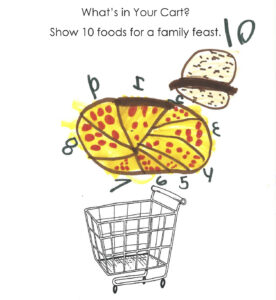 In this second illustration, a child decides that his family will share a pizza. There are 9 slices, and he adds 1 hamburger for his uncle (who doesn’t eat dairy) to make 10.
Sheila Houston, a first grade teacher at St. Margaret of Scotland School in Chicago, had her students make their own books about grocery shopping for a feast. On each page of the book, the students added a different healthy food to the cart in quantities of 10 and calculated the total number of items in the cart. Students were given different numbers of items to start with to build the important skill of finding 10 more and 10 less than any two-digit number (CCSS.MATH.CONTENT.1.NBT.C.5).
Read one of the student’s books [pdf]
This holiday season, give every child the opportunity to engage with important math concepts in the context of their own lives. Using children’s own stories makes learning math more appetizing!
After years of studying 3- and 4-year old children of diverse linguistic and cultural backgrounds, Barbara Sarnecka, a professor of Cognitive Sciences at the University of California-Irvine, has zeroed in on the importance of cardinality as a critical preschool concept. This key understanding is important for children’s learning and seems to be a prerequisite for accurate assessment of their number knowledge.
Once they understand cardinality, we see big improvements on a whole range of conceptual number tasks that don’t even have to do with counting.
Sarnecka recommends a focus on spoken number words along with many opportunities to practice counting and practice subitizing in order for young children to learn about cardinality in preschool.
The Early Math Collaborative, supported by the CME Group Foundation and the Heising-Simons Foundation, held their first biennial conference in 2017 called Promising Math. A conference linking research and practice, the event brought experts from around the United States to discuss the understanding, teaching, and learning of mathematics for children between birth and eight years. The focus for 2017: Fostering access to mathematics for children who are English Language Learners (ELLs).
Moving from one activity to another just got a lot more mathematical with this simple routine that builds early number sense with preschoolers. This dot card transition requires only index cards with 1 to 4 dots in various arrangements. Putting them on a ring makes this a handy and quick routine for those in-between times.
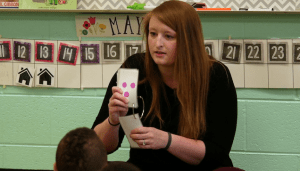
In this video you can see how the teacher asks children to show the same amount of fingers as dots on a given card. Much more powerful than traditional numeral flashcards, dot cards focus children on the cardinal amount of a set of dots, while connecting the number word to its quantity. Having to produce a similar-sized set of fingers requires children to translate from one representation (dots) to another representation (fingers) of the same quantity.
Notice that the dot cards are flashed for just a short time. This routine builds children’s ability to subitize — that is, to see small quantities and instantly know how many in the set without counting. Therefore, while this routine can deepen over time, the dot cards remain small quantities up through 4 (or maybe 5) that children can perceive without needing to count.
Instead, vary the questions you ask over time, such as:
- Can you show me that number of fingers a different way?
- Can you show me the same number of dots using two hands?
- Can you show me one more than the number of dots on my card?
- Can you show me one less than the number of dots on my card?
This routine is easy to differentiate in the moment by the dot card and/or question asked of different children. And, there are low language barriers for dual language learners.
What an effective way to infuse more math into your day!
Transition time is a great time for mathematizing a daily routine. This dot card transition is a relatively simple routine that builds number sense in a concrete way.