The Mathical Book Prize is an annual award organized by the Mathematical Sciences Research Institute (MSRI). With an aim to “inspire a love of mathematics in the everyday world in children of all ages,” the winners are selected by a nationwide committee of mathematicians, librarians, teachers, and early childhood experts.
Looking through the winners, there are some fantastic choices. Among them are three innovative counting books for children in the early years that offer mathematical opportunities beyond the typical counting book. Read how they introduce young children to the principals that underlie the process of counting while having loads of fun.
-
Baby Goes to Market by Atinuke (2018 winner)
Set in a bustling Nigerian market, this book invites readers to bounce along with happy Baby, snug on Mama’s back. Baby charms and delights the vendors so much that he is given gifts—6 bananas, 5 oranges, 4 biscuits, 3 corn, and 2 pieces of coconut—unbeknownst to Mama who is too busy shopping to notice. Baby samples one of each kind of food and then places the rest in Mama’s basket atop her head. The visual humor of the illustrations let us in on the joke as Mama worries that Baby must be getting very hungry, having had nothing to eat.

This book provides an appealing context for acting out market stories, counting and putting groups of foods into a basket. And, not only does this book have a counting down structure, it introduces the number relationship of one less. With every gift of food, Baby puts one less in the basket. He starts with 6 bananas, but only 5 bananas go into Mama’s basket, and so on. What if Baby is given 7 yams, how many go in the basket? What about 8 beans?
-
Count the Monkeys by Mac Barnett (honor title)
Get ready to count monkeys, announces the narrator. Yet, there are no monkeys to be found. Instead, we find a series of different and more numerous animals that have scared the monkeys away. The narrator asks readers to play along in a wild search to find the monkeys, which gets more ridiculous with every turn of the page.

Delightfully silly, this book provides interactive counting opportunities that naturally reinforce one-to-one correspondence. The narrator instructs us, “Say ‘thank you’ six times, very politely” to 6 sweet, old beekeepers who shoo away a swarm of bees. Later, we are told to give 8 lumberjacks each a high five for taking care of a pack of wolves. Alas, the narrator runs out of pages before getting to count any monkeys. A perfect time to talk about what 0 monkeys means.
-
8: An Animal Alphabet by Elisha Cooper (2016 winner)
This book works as an alphabet book, a counting book, and a compendium of weird-but-true animal facts. An alphabet book because over 150 animals are organized from A to Z. A counting book because one animal on each page is pictured 8 times. A “Did you know?” section at the end provides fun facts and helps readers identify the less familiar animals.
The most unique quality of this counting book, however, is the opportunity to find a group of 8 animals on each page. Cooper makes the hunt a fun challenge since the animal that is pictured eight times is not necessarily in the same pose or depicted at the same age or with the same coloring. Discussions of attributes and sorting are bound to happen as readers seek and find sets of 8 on each page. Counting, yes, but which ones are we counting? This book reinforces the importance of naming the unit when labeling the quantity of a set.

The Mathical Book Prize is an annual award organized by the Mathematical Sciences Research Institute (MSRI) with an aim to “inspire a love of mathematics in the everyday world in children of all ages.” We previously highlighted some of their selected titles that introduced children to the principals behind counting.
In another look at books awarded the Mathical Book Prize, we focus on three books that go beyond one-to-one counting. These books provide compelling contexts that help primary grade children understand why more advanced counting is useful and that it isn’t always efficient to count by ones.
-
Sheep Won’t Sleep by Judy Cox
 Sheep Won’t Sleep (2018 Winner) brings a colorful and creative twist to the dilemma of what to do when counting by ones doesn’t work. When she tries counting sheep, Clarissa’s eyes pop open to discover 10 wooly sheep crowding into her bedroom. So she tries counting alpacas by 2’s only to have 20 of them join the sheep. When she switches to counting llamas by 5’s, 20 more wooly critters show up; counting yaks by 10’s brings another 50 creatures. When she counts them all back down, rolling all their wooly threads into a ball, Clarissa finally gets to sleep.
Besides the pictures of ever-increasing groups of wooly animals, this book invites questions about how to select the most efficient “friendly” number for skip counting. Create a large classroom chart (that might be fun to share on a classroom bulletin board) about what collections might be best counted by 2’s, 5’s or 10’s. An easy place to start is to figure out how many body parts in total there are in the classroom. It’s easy to count eyes and ears, hands, and feet by 2’s, for example. In the same way, counting how many fingers or toes calls for counting by 5’s and might also be done by 10’s. It might be fun to have groups of children work on illustrating the chart as well as writing out the counts. -
Max’s Math by Kate Banks
 The idea of counting sheep to get to sleep comes up again as a way to end a busy night described in Max’s Math (2016 Winner). Max and his brothers travel though Shapeville and Count Town, passing many sets of things to count such as five clouds, two buses, four triangles, and one square. They find numbers everywhere they look! Have your students look for everyday collections of things that come in equal sets (i.e. pairs of shoes, boxes of crayons, packs of trading cards) to make their own counting stories.
 -
One Big Pair of Underwear by Laura Gehl
One Big Pair of Underwear (2015 Winner) is bound to appeal to 5- to 8-year olds who think just the word underwear is hilarious. However, they are virtually sure to be willing to continue through the book, playing with the idea that when you have an even number of objects and an odd number of critters who want them, it just isn’t fair! For example, if you have 4 large jars of candy bars and 5 greedy goats in red cars, there’s nothing left for the 1 goat who drives up to find 4 empty jars and no candy bars. It isn’t until 20 pigs decide to go piggybacking and take rides on 10 slides that everyone else decides that sharing might be the way to go. The final pictures show all kinds of sharing and swapping going on that kids can have a grand time putting into number sentences. Once they have done that, many might love to pair up with a classmate and think up some fair share tales of their own that push mathematical thinking into more advanced counting and beyond one-to-one counting.


Sets are basic to children’s thinking and learning. They are also basic to our number system. One of the most important jobs of each number is to describe “how many” there are in a set of things — be it one, seven, or three hundred and nineteen. Before we can figure out how many apples there are, we have to decide which things are apples, and which are not.
Books are a powerful way to launch math investigations with children, but also with adult learners. Our Learning Labs often use picture books as a doorway into mathematics. Here, teachers explore multiple representations of the number five in Anno’s Counting Book by Mitsumasa Anno. It is critical for teachers of young children to appreciate the complexity of language about numbers and their various meanings.
Adult learning videos are portions of professional development sessions designed to engage adults in a meaningful way. They are not activities meant for recreating with children. Learn more about our Whole Teacher Approach and Learning Labs.
Long before young children are writing equations with the equal sign, they are exploring how amounts that look different can actually be equivalent.
Ideas about equivalence develop through everyday, concrete experiences that require children to find something that is the same as something else. Imagine a child figuring out how to fill a space in a block structure when the desired shape is not available (two isosceles right triangle blocks are the same as a square block) or sharing colored candies with a sibling (my 3 reds and 1 yellow are the same as your 2 reds and 2 yellows).
The following books offer engaging visual representations of equivalence—in the form of balance and equivalent representations of numbers.
-
Balancing Act by Ellen Stoll Walsh
This animal tale of mice on a seesaw is one of our favorites. Two mice, one on each side, balance just fine on the seesaw they are playing on. But when you begin to add more colorful animals to each side, you get different results.
Balance is a powerful, intuitive metaphor for equivalence. You can use a kinesthetic approach and have children extend their arms to look like a seesaw. They can act out what happens in the story as animals come and go from the seesaw. Draw children’s attention to the idea that if you have a balanced seesaw and change only one side, then the two sides are no longer equal and the seesaw will tilt. However, making the same change to both sides maintains a balance.
A pan balance scale and small animal toys is a great way for children to continue exploring this idea of equivalency.
-
Twelve Ways to Get to Eleven by Eve Merriam
This book by poet Eve Merriam introduces a perplexing problem: Where did 11 go? The story leads you to find 11 on each turn of the page, but in many different ways. For instance, out of a magician’s hat you find four banners, five rabbits, a pitcher of water, and one bouquet of flowers. As you discover many collections of 11 things, you realize that all of the 11-collections are equivalent amounts, even if they are made up of vastly different things.
Make your own class book of Many Ways to Get to X. Select a target number and have children draw or make collage pictures that represent that same number in different ways. Reinforce the idea that even though each page looks different, they all show the same number of things.
-
One is a Snail, Ten is a Crab by April Pulley Sayre
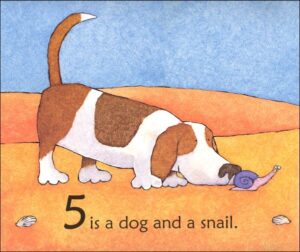
 This silly counting book tallies up the number of feet of various animals. It begins with a snail, which only has one “foot,” and then goes on to a human with two feet, a dog with four feet, and so on, up to a crab with ten feet. Larger numbers are represented in more than one way such as “40 is four crabs…or ten dogs.” The illustrations of animals playing at the beach keep the book fun and invite you to imagine many wacky combinations of animal feet.
In the primary grades, have children write their own Feet Riddles, such as
- If you have 3 crabs and 2 dogs, how many feet?
- If you put 2 insects with me, there are 20 feet. Who am I?
- There are 11 feet. There are no crabs and no humans. Who are we?
- 2 spiders’ feet are equal to a crab plus me. Who am I?