Some time ago we listed some books we not only like for their rich stories and pictures, but because they provide great opportunities to explore the beginnings of geometrical thinking in young children. And now here are more! For kids’ books, geometry doesn’t have to be just reciting shape names. Here are books that can begin rich discussions involving shapes, spatial sense, and the geometry found in the world around us.
-
Block City by Robert Louis Stevenson, illustrated by Daniel Kirk
This wonderful look at playtime takes the form of a classic poem by Stevenson and is accompanied by amazing illustrations by celebrated artist Daniel Kirk. Because the weather is rainy, a boy must entertain himself inside, and so he begins to construct a city with blocks. Sofas become mountains and carpets become the sea. It is a very relatable story that naturally encourages building block cities of your own. If your looking for geometry books, you hardly can’t go wrong with using blocks as an entry point.
-
Grandpa’s Quilt by Betsy Franco
Here is a story of grandpa and a terrible dilemma he is faced with when he is going to bed: his feet are cold! In the fun problem-solving that ensues, we find several attempts to fix his quilt so that it fits him just right and his toes can feel comfy when he sleeps. Cutting and reshaping the quilt is something that can be recreated and explored in multiple ways with paper and scissors, allowing for the story to leap out of the pages. And it allows children to think through the Big Idea that shapes can be combined and separated (composed and decomposed) to make new shapes.
-
Color Farm and Color Zoo by Lois Ehlert
These books explore similar concepts to Pat Hutchins’ Changes, Changes in a slightly different way and with one of children’s favorite topics: animals. Let the shapes build upon each other, with each page of this geometry book creating a rooster, a duck, a chicken, or some other colorful animal. Along the way questions can be posited to guess what animal could be next and how, or any number of other interesting ways of exploring the shapes. Children can create shape collages in the style of Ehlers’s art.
-
I Spy Shapes in Art by Lucy Micklethwait
There was Where’s Waldo? and then there was I Spy Shapes. Find shapes in famous pieces of art! With an interactive opportunity for children to explore paintings by such renowned artists as Henri Matisse, Georgia O’Keeffe, and M.C. Escher, it is a great way to make a game out of learning shapes as well as a first introduction to fine art.
Thinking about sandwiches cut in half leads this boy to explore shape composition and equivalence with blocks. The teacher pushes his thinking by joining in the play and ordering a whole sandwich of the same size. Block play in kindergarten can be full of math.
Children, even at a very young age, have an incredible understanding of spatial relationships. Jan de Lange brings up the idea that elementary school classrooms might consider starting their math curriculum with spatial reasoning. Ideas such as numbers and counting could be added later to quantify this concept that children naturally understand so well.
Imagine you have a house with forty rooms. I can bet you that your three year old will know exactly where the sweets or his favorite toys are after you show him once–in three dimensions!
Jan de Lange is the founder and director of Jonge Ouder Academie (Young Parents Academy), an institute for parents of children ages 3-7 that facilitates learning at home, complementary to learning at school. He is also an Emeritus Professor at the University of Utrecht in the Netherlands and a past chairman and director of the Freudenthal Institute.
The Early Math Collaborative, supported by the Robert R. McCormick Foundation, held international symposia in 2009 and 2010. The two events brought experts from around the world to share approaches to early mathematics education with teachers, administrators, policy-makers, and other education professionals. The goal was to generate globally-informed ideas and recommendations for improving math instruction in the early childhood classroom. In breakout discussions and plenary sessions, participants brainstormed ideas, identified issues, and recommended actions.
This article outlines the benefits to spatial reasoning and expanding the learning that children experience regarding spatial reasoning in the early years.
Cutting paper hearts for Valentine’s Day math fun is a common, early experience with symmetry for many young children. What joy to open a folded paper and discover a heart with two identical sides!
A shape has reflectional symmetry (also called line or mirror symmetry) if there is a line going through it that divides it into two halves, which are mirror images of each other. Folding a piece of paper creates this line, or axis of symmetry, and any shape cut along the fold will be reflected on the other side.
Have plenty of red paper on hand? Allowing children to explore where to fold and how to cut valentine hearts on their own leads to many discoveries. If the axis you fold at is not in the right place, the two halves aren’t identical at all.
Children are naturally curious about symmetry, so here are some more ways to explore symmetry that your children will love.
 Exploring with Mirrors
 Exploring with Mirrors
Provide children with cards showing geometric shapes, letters, and numerals and small mirrors. Allow children time to become familiar with ideas of symmetry and reflection. Then ask questions such as, “When you put the mirror there, does the shape look the same on both sides or different?” or “Can you find a place to put the mirror so you still have a letter H? or a number 3?
Exploring with Blocks
Children naturally create block designs and structures with symmetry. As they add a block to one side, they add a block to the other to maintain balance and create a pleasing harmony of shape and form. 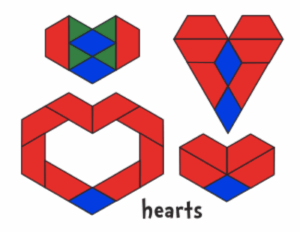 You can nurture this interest by providing photographs of famous buildings and helping children notice their symmetrical features (those of us in Chicago are partial to the John Hancock Center). Can they replicate these famous buildings in the block corner?
Adding mirrors to play with pattern blocks invites more investigations with symmetry.
Exploring with Books
For books that can extend thinking about shapes and their attributes, check out When a Line Bends… A Shape Begins by Rhonda Gowler Greene or Color Farm by Lois Ehlert. Both have a heart or two in them but include many other shapes to explore as well.
Examining sets of unit blocks challenges educators to think about relationships since all the blocks are fractional units or multiples of one another. A deeper understanding of the features of unit blocks empowers teachers to support children in ways that promote joyful math learning.
Adult learning videos are portions of professional development sessions designed to engage adults in a meaningful way. They are not activities meant for recreating with children. Learn more about our Whole Teacher Approach and Learning Labs.