Children explore the everyday shapes in their environment from birth. They informally learn about the properties of 3D shapes as they mouth, touch, and play with blocks, balls, and other objects in daily life. Long before children have language to name or describe these different types of shapes, they develop intuition about which shapes roll, how a flat surface feels, and that “corners” are pointy.
Though we live in a 3D world, common language and materials used to teach children about shapes focus on 2D shapes. In fact, the majority of emphasis gets put on just four shapes: circles, triangles, rectangles, and squares. And these shapes are usually presented in only one typical way so that children often develop rigid and fixed notions of what shapes must look like.
So it’s up to us to find, share, and talk about a variety of shapes with children in ways that expand their understanding and build connections between shapes (think, how is a square a special case of a rectangle?) and connections between the shapes drawn on paper and the concrete objects in our world.
Take triangles for example. Most children’s books present triangles as equilateral (3 equal sides) and oriented to sit on a horizontal base. As a result, children may not recognize isosceles and scalene triangles as triangles because they look “stretched out.” Children may say that a triangle with a vertex pointing down is “upside down.” Watch a small group discussion about “upside down” triangles during a preschool activity called Feel for Shapes.
 Talking about diverse shape examples along with nonexamples can go a long way to help children understand what defines a shape—what makes a triangle a triangle, for example. Nonexamples are highly visually similar to a type of shape but lack at least one defining attribute.
Luckily, it’s easy to find nonexamples to discuss in everyday life. How often might we point to a piece of pizza and call it a “triangle?” As adults, it’s not our main concern to correct children’s language, but to listen to what shape knowledge children reveal by what they say and to build on it. So, if a child says a pizza slice is a triangle, you might ask them why they think that. Likely, the child will have noticed that the slice has three sides. This is a great opportunity to focus on the defining attributes of a triangle. For example, you might say, “Yes, I see three sides, but the crust side is curved so it’s not exactly a triangle. Triangles have three straight sides.”
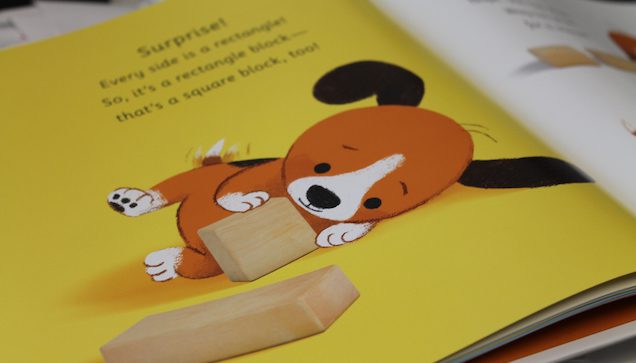
Going on a “Shape Hunt” in real life or through picture books such as Shapes, Shapes, Shapes by Tana Hoban is bound to turn up many common 3D objects that get labeled with 2D shape names. This is a great opportunity to help children see the relationship between different types of shapes, particularly 2D and 3D shapes. For example, many children will say that a ball is a “circle” because it is round. You can acknowledge what the child knows while pushing for greater precision—“Yes, the ball is round like a circle, but it’s not flat. A ball is round in every direction so we call its shape a sphere.” The book Now What? A Math Tale by Robie H. Harris tells the story of Puppy putting together blocks to build a bed that’s just the right size for a nap. As Puppy solves problems, readers get to explore how 2D shapes are the flat faces of 3D prisms and share in the delight of discovering “a rectangle block—that’s a square block, too!”
Most of the world around us is not made of regular 2D shapes the way they are drawn in simple shape books and posters. And that’s okay. What a wonderful opportunity to start a conversation with children about different types of shapes and the attributes of shapes!
Surprise!
Every side is a rectangle!
So, it’s a rectangle block —
that’s a square block, too!
Books can illustrate kindergarten and preschool shape concepts while introducing foundational Big Ideas of math. These activity cards can help take the learning to the home environment where parents and caregivers can spark such discussion.

Round as a Tortilla
This book by Roseanne Thong beautifully illustrates various aspects of Latino culture while introducing some mathematical and geometrical thinking. This activity card can help parents and caregivers find shapes in their own contexts.

Shapes Shapes Shapes
This photo book by Tana Hoban compels readers to engage with the photos, to ask questions and discuss attributes of shapes found in everyday life. This at-home activity card can help initiate such kindergarten and preschool shape talk.
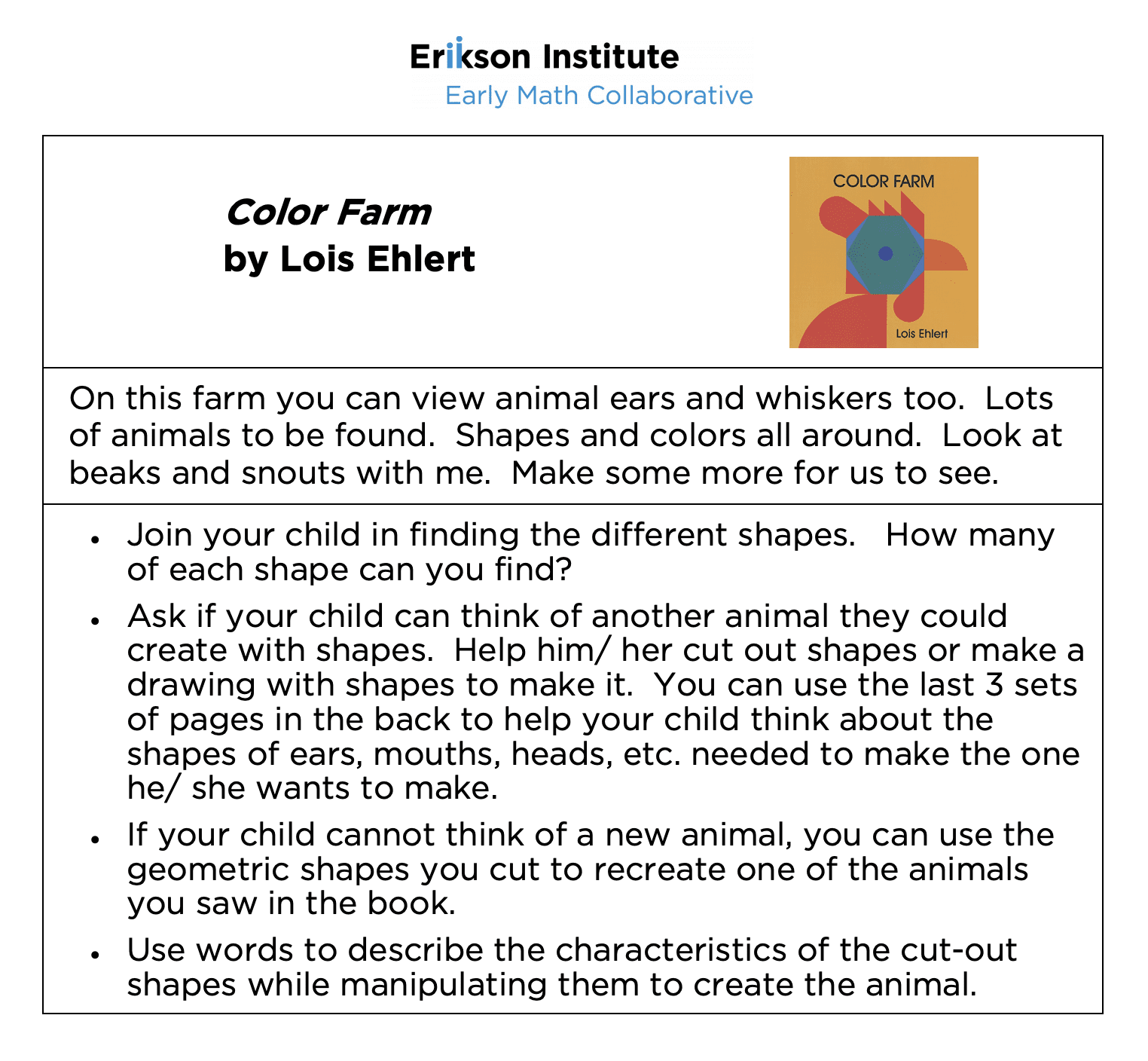
Color Farm
This book by Lois Ehlert introduces the reader to farm animals with a focus on shapes such as octagon, hexagon and square. This activity card in both English and Spanish can be a great jumping off spot for parents and caregivers to explore shape composition–that is, how smaller shapes can form larger shapes.
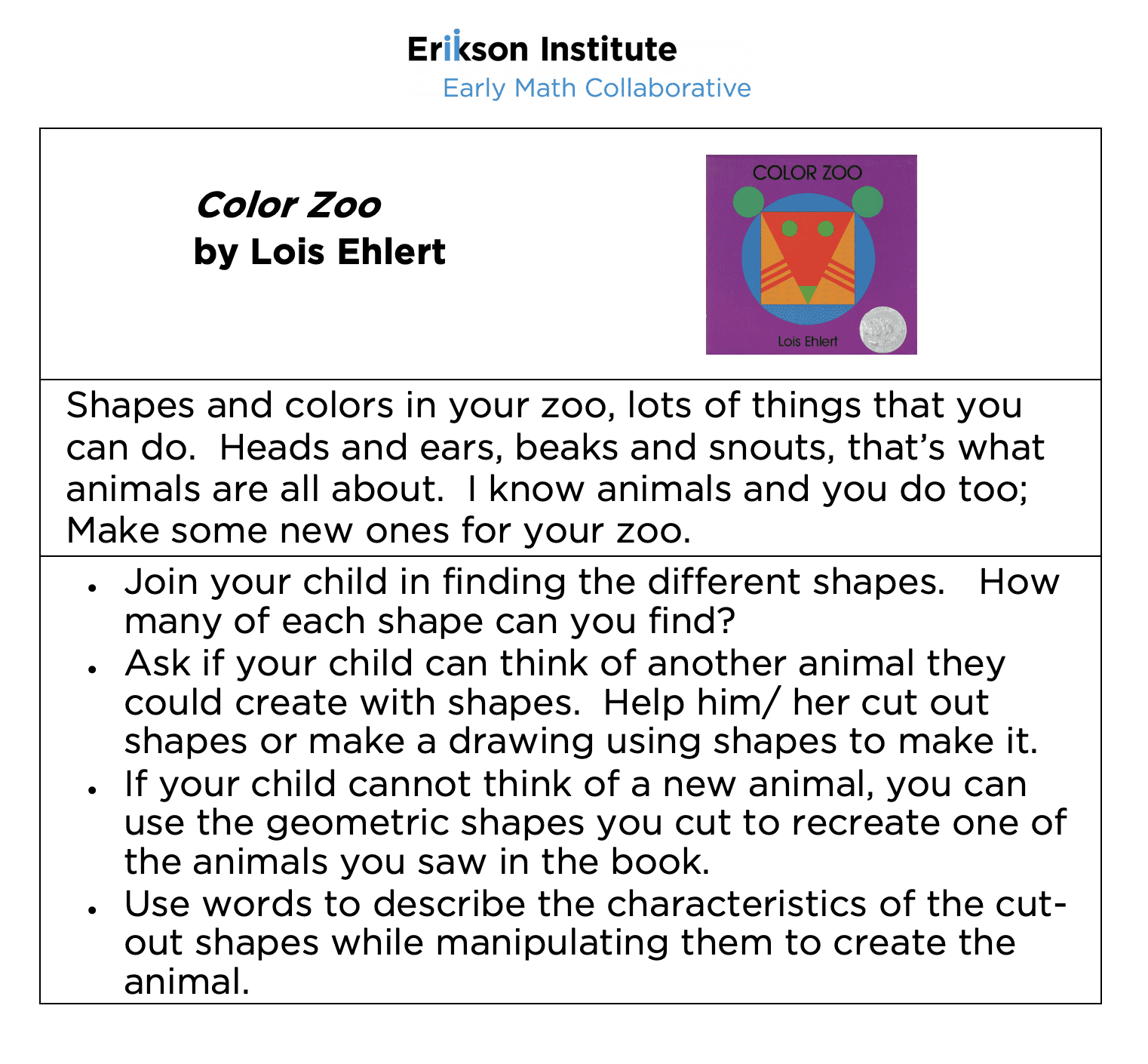
Color Zoo
This other book by Lois Ehlert uses zoo animals, rather than farm animals, and uses the turning of the pages to introduce new shapes (and animals) in a fun and engaging way. This activity card can help parents and others to explore kindergarten and preschool shape concepts in fun ways at home.
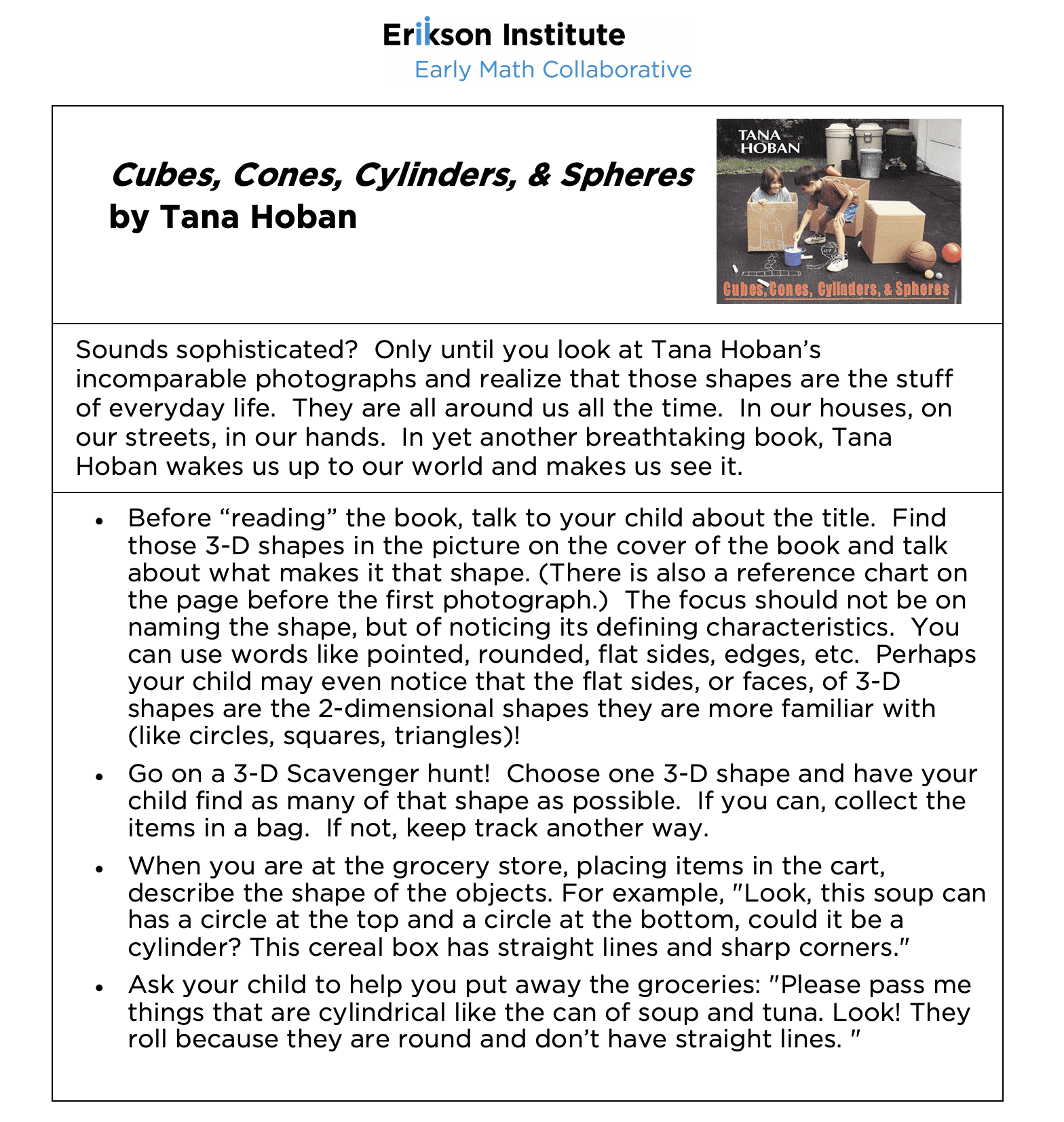
Cubes, Cones, Cylinders, & Spheres
Another one from Tana Hoban, this book offers photographs of shapes in a real-world environment. This activity card provides an opening to delve into finding 3-dimensional shapes in a home math environment.
Browse all ourdownloads
You’re logged in! That means you have access to a lot more downloadable early math ideas.
Jigsaw puzzles are a great way for children to develop their spatial thinking and problem-solving skills. Children enjoy doing all kinds of puzzles and making ones from materials found around the house keeps it fresh and new. Do It Yourself puzzles (or DIY puzzles) allow you to adapt and create them to address your child’s personal skill level and age. For a child new to doing puzzles or a young child, you might make a puzzle with just 5 or 6 pieces, but for a more experienced child, you might make a puzzle with 12 pieces or more.
You can make many different puzzles by using any type of cardboard box you have around the house and your own picture (a photo, poster, magazine page, or your child’s drawing). You can even use the design of the box itself such as puzzles made from the cardboard of your favorite cereal box. Here is what you’ll need and the step by step directions.
Materials needed:
- Cereal box (or other cardboard boxes you have around the house)
- Pencil
- Scissors
Optional material:
- Photo, poster, magazine page, or drawing
- Glue
- Dark marker
Directions:
- Choose either the image on the box or to use your own picture.
If you are using the image on the box itself, skip to Step 2.
If you are using your own picture, glue the image onto your cardboard and let it dry completely, at least two hours. - Cut along the edges of your picture to make the border of your puzzle.
- Flip the cardboard over and use a pencil to mark the lines of your puzzle pieces on the box. If necessary, trace the lines with a black or dark marker.
- With scissors, cut along the lines.
- Now you have your puzzle! Put the pieces in a plastic bag to make sure they stay together.
There are many ways to build conversation related to spatial relationships and shape into doing DIY puzzles. You can cue your child to do spatial thinking and look at the shape of the puzzle piece to think about where it might belong. Give hints that still let children figure it out for themselves, such as:
- “The shape of that piece makes me think it goes next to/below the one at the top.”
- “Let’s turn/flip that piece around to see if it fits near the bottom.”
Some questions you might ask include:
- “By looking at that piece, where do you think it might fit?”
- “Which way do you have to turn/flip that piece so it will fit?”
- “What makes you think that?”
As children get more experience, they can make their own puzzle or a puzzle for you. Have fun!

Every day dishes need to get cleaned, and every day dishes need to get put away. It might not seem like an important task… until there are no spoons for your morning cereal! By involving children in chores like doing the dishes, you can help them see mathematics in the work and turn an everyday task into a math task. And even better if you get some help in everyday chores around the house!
Enough is Enough – Measurement
There are many different size comparisons happening throughout your dishwashing experience. That means there are good opportunities for you to provide measurement-related language while children are already engaged.
Essentially, any time you talk about amount – how much, whether more or less would be better, which is smaller—you are talking about math relationships. Just noticing these opportunities and using language to point them out really mathematizes the dishes!
Mother and daughter compare sizes of “baby spoons” and “daddy spoons” in their home language, Gujarati.
Here are some examples of how measurement can be found in your dishes routine, making it a math task:
- Organizing which dishes will be washed first: “We’ll start with the little things, like utensils, and save the big things for last.”
- Explaining how you decide how much water to put in your sink or basin: “Let’s fill it right up to that line—that’ll be enough for the pans to get soaked.”
- Deciding how much dish soap to use: “If we use too much, the bubbles will get all over and we won’t have enough left for tomorrow.”
- Putting dishes away: “The short spoons go in this tray, and the long spoons go in that one.”
Give your Dishes a Spin! – Spatial Relationships
It’s also true that most of the dishwashing task is consumed with moving objects around. To do that effectively, we all make judgements about whether there is “enough room” and we rotate and flip objects to clean and organize them. This kind of spatial thinking not only connects to geometric thinking but has been shown to connect to many different kinds of math tasks.
Singing makes chores a lot more fun! Use a familiar tune and sing as you work. Here’s a song in Gujarati.
Here are some of the opportunities you might see:
- Bringing all the dishes from the table to the counter next to the sink: “Let’s stack the plates on top of each other here, right next to the bowl.”
- Loading the dishwasher: “Put the forks with the tines up, like this, so they have a better chance to get clean.”
- Hand-washing the cups: “It’s good for you to get the cloth all the way down inside the cup to the bottom to get all the milk out.”
- Putting dishes away: “The pot lids go in the drawer under the microwave.”
Setting up for success
Just a reminder to be patient the first time you try involving your kids in cleaning up the kitchen. Start small and give little ones ample time. It might take you 10 minutes to complete the task on your own and 20 minutes or longer with your children but trust that process will get easier. Plan on sticking around to share the work – children will need your support and your supervision. When you layer in math language about size and spatial relationships, then your dish-washing does double duty. Clean dishes AND math learning: a win-win situation!
When you layer in math language about size and spatial relationships, then your dish-washing does double duty. Clean dishes AND math learning: a win-win situation!
A tangram puzzle consists of seven pieces — five triangles and two quadrilaterals made from one square. Tangrams originated in China hundreds of years ago. They traveled to Europe in the 1800’s, where they gained global fame. These seven pieces are used to create thousands of unique figures. A tangram puzzle shows only an outline or silhouette of a figure, and the puzzle solver must create it, using all seven pieces. This requires spatial reasoning as one flips, slides, and rotates the smaller shapes to compose the larger tangram shape.
You can make your own set of paper tangrams by following this easy, step-by-step video. All you need is a piece of paper and a pair of scissors to make these do-it-yourself puzzles. Then, get creative!
Ms. Chen, a second-grade teacher at St. Therese Chinese Catholic School in Chicago, integrates art with math when she uses tangrams with her students. Her math focus is spatial reasoning and shape composition.
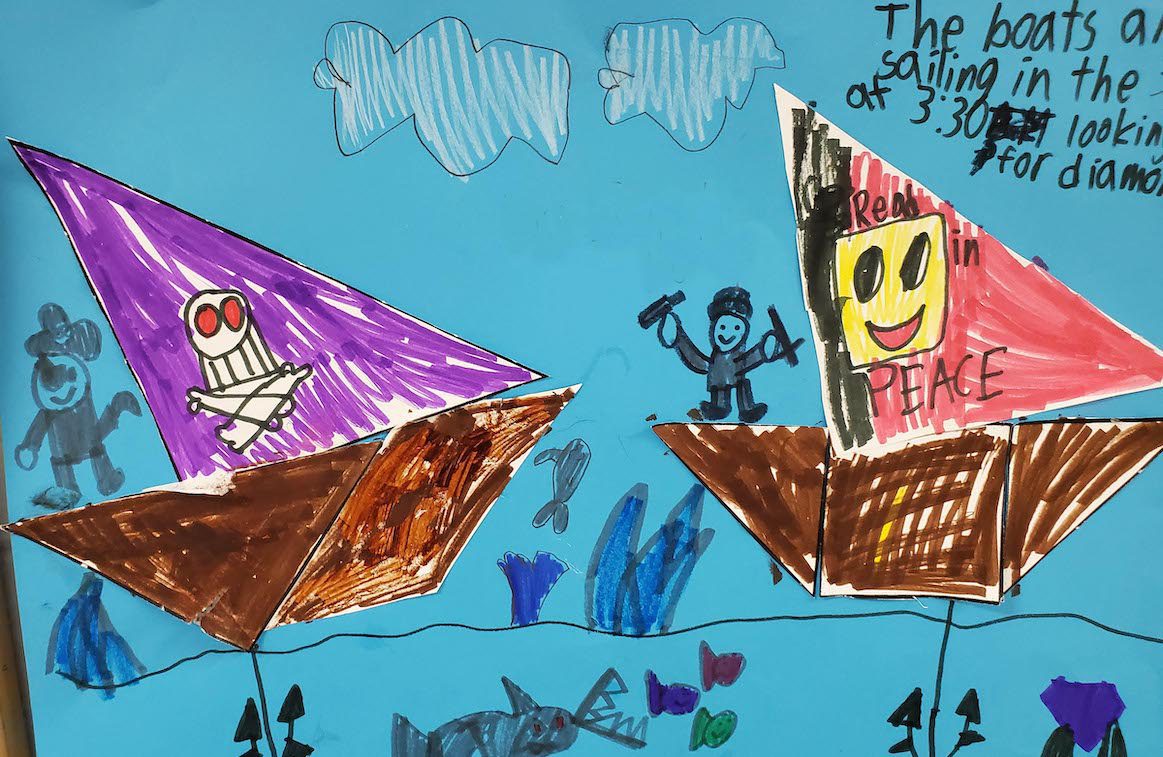
Ms. Chen begins the exploration by reading Grandfather Tang’s Story by Ann Tompert, and you can listen to the story here. Have children explore the tangram shapes by trying to create the large square from which they came. Next, try to make the animal figures from the story. Then, invite children to create their own figures, following the rules of tangram puzzles. The rules state that you must use all pieces, each piece must touch another piece, and none of the pieces can overlap. Look at some lovely examples from the 7- and 8-year-old children in Ms. Chen’s class!

Why use tangrams?
Tangram puzzles help learners develop an understanding of the big ideas about shape and spatial relationships. Spatial reasoning is the capacity to visualize relationships between shapes and manipulate shapes through turns (rotations) and flips (reflections), both physically and mentally. Developing children’s spatial reasoning deepens their understanding of geometry as well as develops flexibility for problem solving. Working with do-it-yourself tangram puzzles—at home or at school—can really help your child’s creative, mathematical thinking take shape!
Warm weather and more daylight hours mean now is a great time to take advantage of outdoor spaces. There are so many ways to incorporate math into your child’s outside activity. Obstacle Courses and the Bean Bag Toss are two fun outside activities for kids that are already rich with math: spatial awareness, geometry, measurement, number sense, and counting… you can even find ways to develop data analysis!
Obstacle Courses
There is a lot of math to be found in obstacle courses, from planning the course and the actions to describing the movement as you go. With older children, you can incorporate measurement and data analysis.
Highlighting the math in Obstacle Courses:
- Use household items, such as sheets, brooms, pots, tables, and chairs and/or outdoor items such sticks, rocks, and trees to create the course. Together you can design the shape of the course: will it be circular, straight or something else?
- Call out what to do when they get to each obstacle using directions that develop spatial relationships; “walk over the broom,” “walk around the tree,” “step on the stick,” “crawl under the sheet,” etc.
- After designing and creating the course outdoors, older children can use a stopwatch to time how long it takes to complete the course. Record each time they do the course and compare the results to see if they are getting faster and use the data to analyze why or why not.
- Children can also draw a map of the course, either before as part of the planning process, or after as a way to share their fun with others. Be sure to have them include arrows that show the movements and actions.
- You can also involve measurement with obstacle courses by comparing the length and heights of the different obstacles. To keep your obstacle course exciting, after you measure the obstacles, you can decide if you want to change them and measure how much taller, shorter, longer, or wider you want to make them.


The best part using an obstacle course is that you can change it whenever you want. Children stay interested and use it over and over again.
Bean Bag Toss
Cornhole or Bags are popular games at many summer gatherings. These are family-friendly outside activities for kids that any age can play. While playing, they develop counting skills, spatial reasoning, and measurement. You don’t even need a board with a hole in it to play. You can easily create your target with household items and play in the grass , or draw your target with chalk on the sidewalk.
Highlighting the math in Bean Bag Toss games:
- With younger or less experienced children, use a hula hoop or draw a circle with chalk on the sidewalk. Use five bags to toss towards the target. No bags? You can even use sponges or balls of socks! After the child tosses the bags, talk about how many bags are in the circle and how many are outside the circle; are the bags near the target, or are they are far away from the target? Talk about how there are still five bags, even though there are some bags inside and some bags outside the circle.
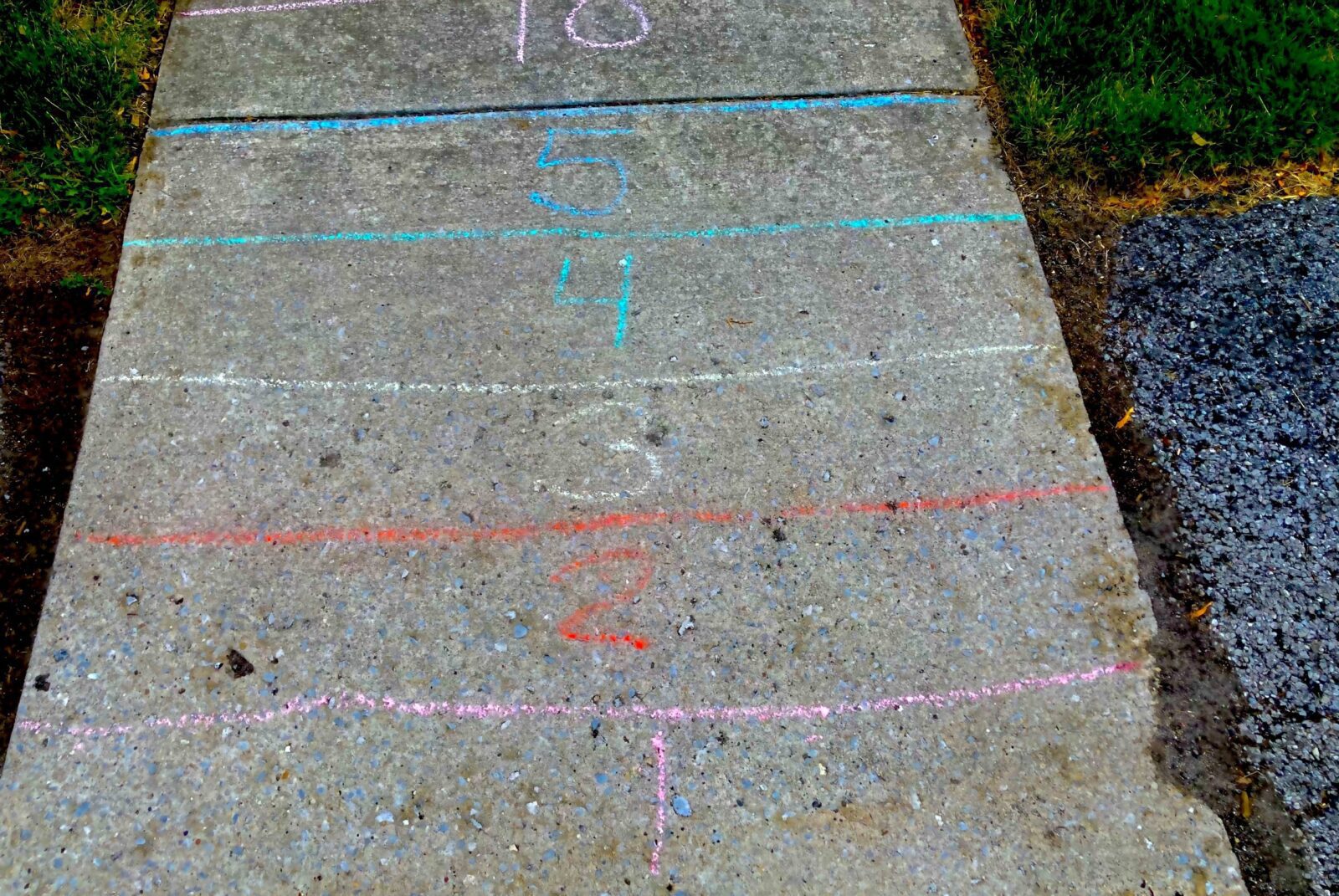
- Older or more experienced children can draw a multi-leveled target with different point values on the sidewalk and record their points.
- Play Bean Bag Toss as a carnival game by drawing a row of circles on the sidewalk or placing buckets, pots, or other types of containers in a row. As you create the row of chalk circles or buckets, you can measure to make sure there is equal distance between each one. Additionally, you can measure the length of the entire row. Start with just three spots and add on to make the row longer.
- If you are playing with chalk on the sidewalk, you can create a “scoreboard” for your child(ren) to fill in.