Putting groceries away is necessary work for families. Sharing this work with our children turns an everyday task into a hands-on shape activity — if we slow down and let them figure things out for themselves!
Start by including children in the work in a meaningful way. You might say, “This a heavy bag of groceries! Let’s put the food away so we know where to find it when it’s time to cook.”
Unpacking the grocery bags
Children will begin to notice how some groceries are similar or different by categorizing food packages as they set them out on the kitchen counter or floor. Groceries come in a variety of shapes and sizes. Cans of soup or beans and jars of pickles or peanut butter can be grouped together; so can boxes of cereal, pasta, or crackers. Having a conversation about why cans go together and boxes might go together in another group brings math into this household work.
I notice you’re stacking the boxes flat, on top of each other. All four fit.

If we push the boxes over, the milk carton can stand up here.

Filling up the cabinet
The conversation you and your child have while placing items on the shelf or in the cabinet can be a way to discover shape characteristics. For example, stacking cans on the flat side versus the curved sides. Children can explore how many cans they can stack to fit inside the shelf; certain items may be too long or wide to fit.
Oh no, the cans are falling out!
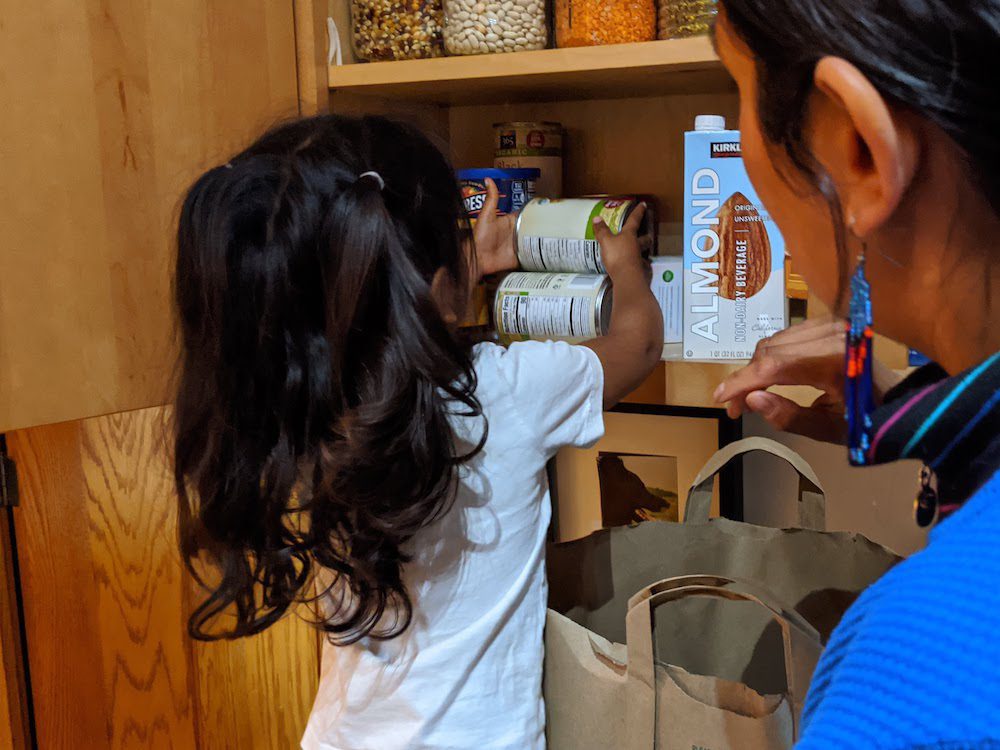
If it stands up, then it won’t fall over.
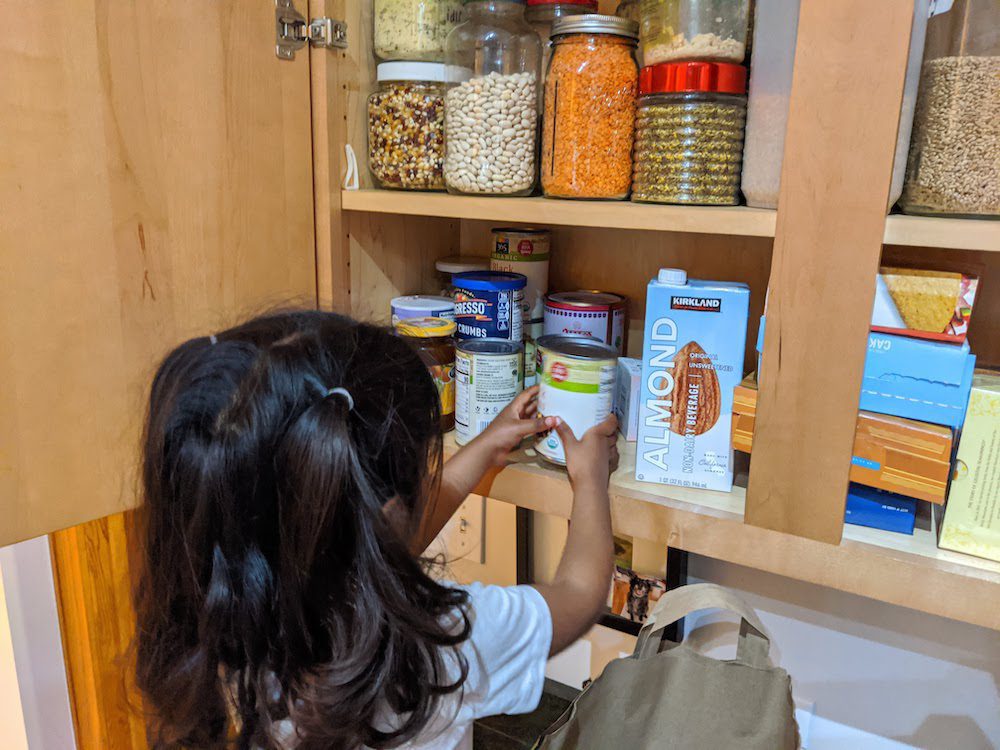
Solving problems with spatial reasoning
When we offer children space and opportunity, we can observe their many attempts to fit items into the cabinet only to stop and restart. The work of trial and error is very beneficial to developing their understanding of the characteristics of shapes. We might watch before we support them with language such as “I notice that long can of Pringles doesn’t fit, it is taller than the cabinet space.”
Let me try the peanut butter jar. Nope it doesn’t fit.
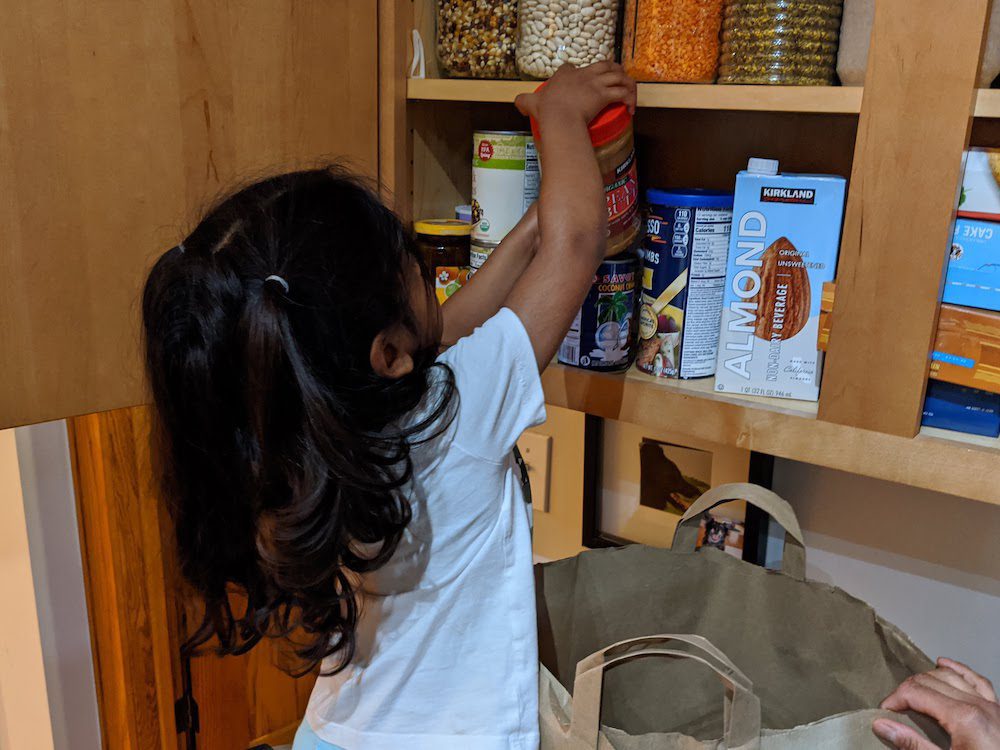
This jar fits on top of the peanut butter.

Use a simple homemade playdough recipe to cook up some shape fun! Stamping or imprinting playdough with everyday household items is an active way for children to explore the big ideas of shape, including the discovery that 3-dimensional objects are made up of 2-dimensional shapes. For example, a spaghetti box is made up of six rectangles of three different sizes. A can of beans has two circular bases of the same size. As children flip, turn, and slide these shapes during play, they develop and deepen their understanding of shapes properties such as flat or curved surfaces and pointy or square corners.
Starting in infancy, children interact with the world largely through object play such as rolling a ball, building a tower, or climbing inside a large cardboard box. You can bring out the math when you add language to describe what and how they are interacting with the different objects in their world. Young children do not yet possess the formal words to express what they are noticing about shapes and their properties, but we can use math language and gestures to guide them.
Playdough is a rich material for children to engage in play; there is no limitation to what you can create. To begin, follow this homemade playdough recipe to make the dough and collect common household objects of a variety of shapes for printing. You can find these items in your cabinets and your recycling bin, such as empty toilet paper or paper towel rolls, cans, caps, and small boxes such as a toothpaste box or small jewelry boxes. Use items that will fit in your child’s hand and create an imprint in the playdough.
Once you’ve made the playdough and gathered all the objects you plan to use, ask your child to roll out and flatten the playdough. How can they do that using one of the objects? Which objects roll and which ones don’t?
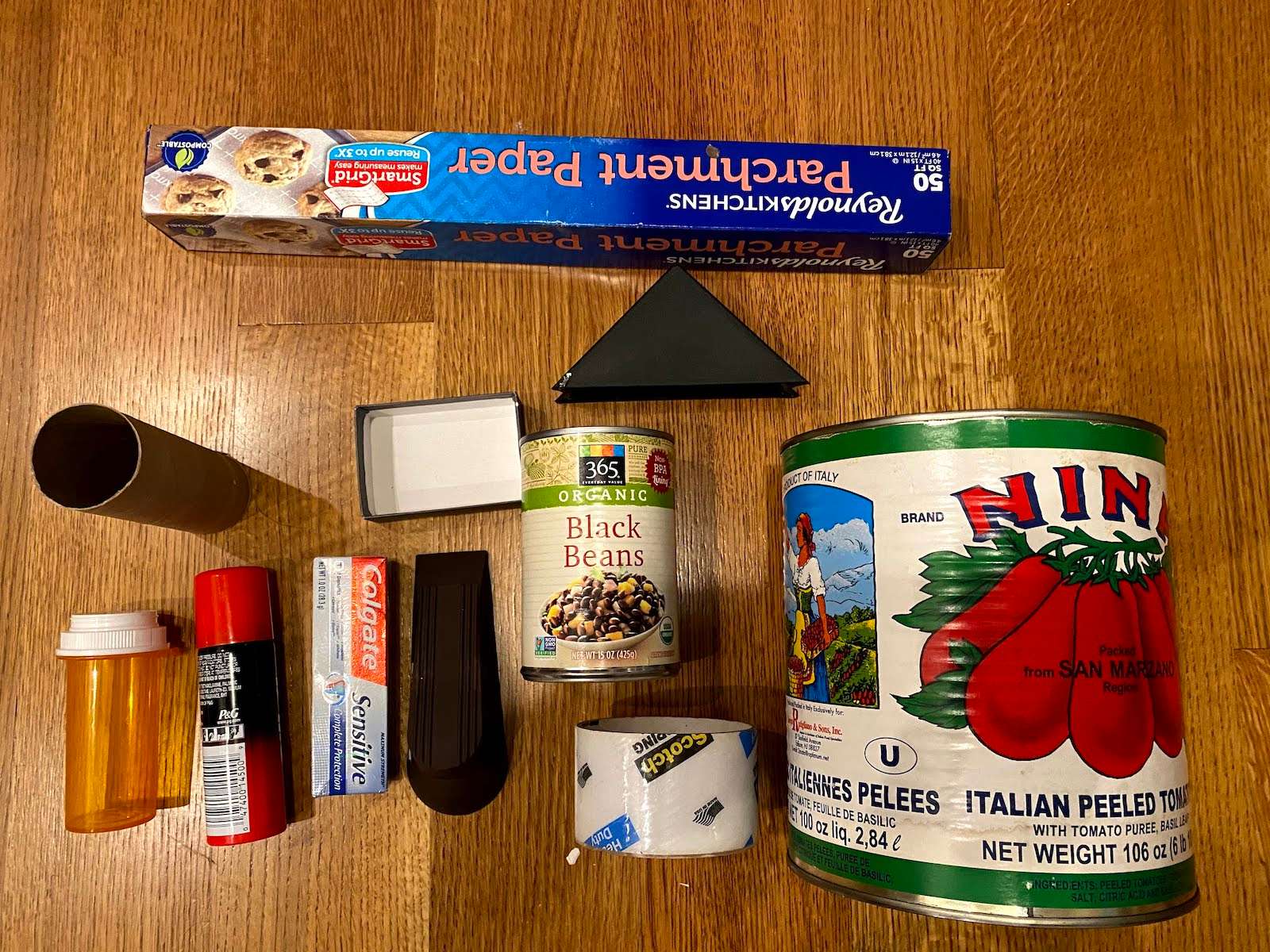
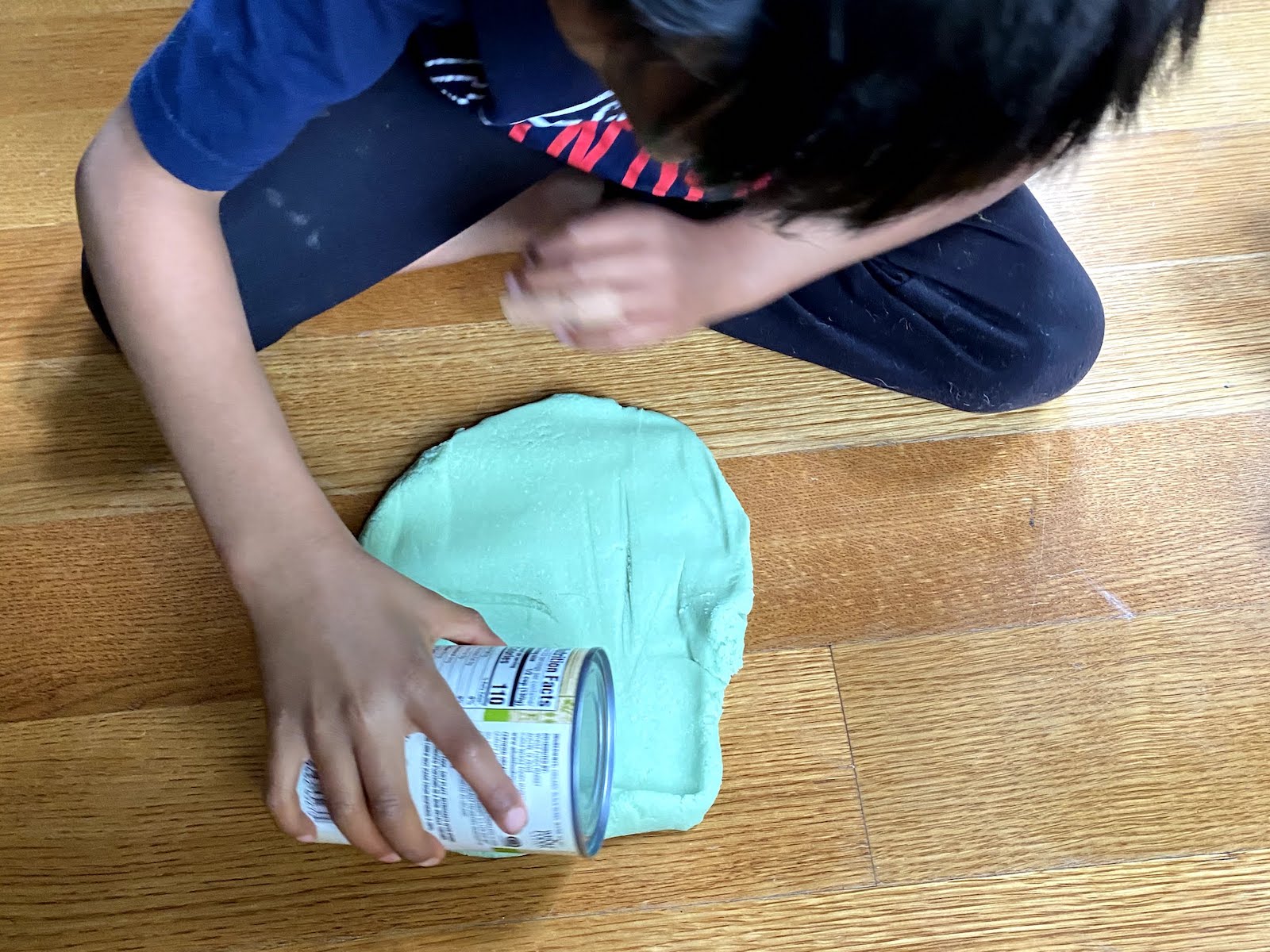

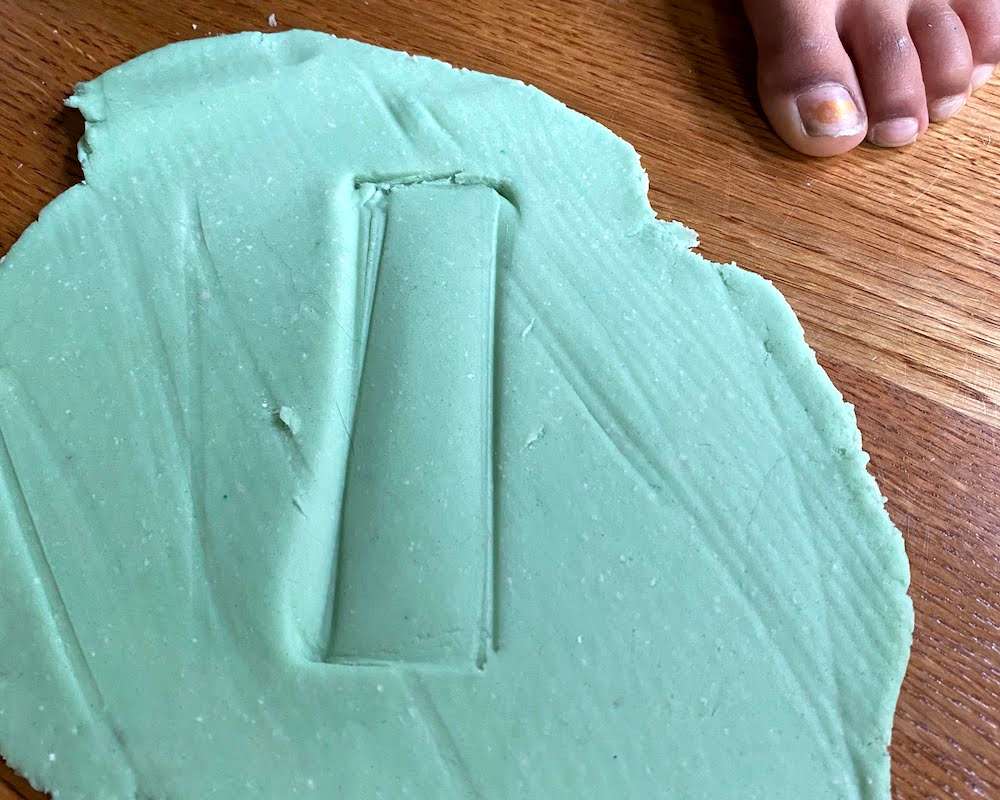
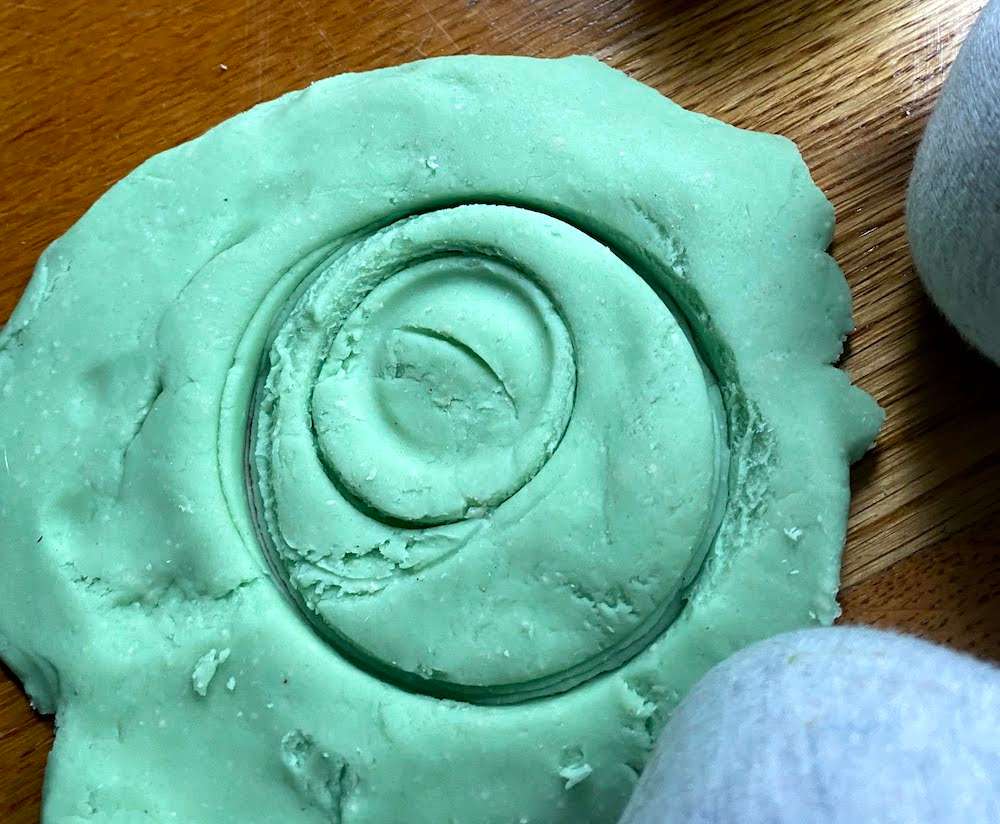
Your role is to layer the experience with what you notice the children discovering. “When you pressed the lid into the playdough, it made a circle!” or, “Look at four lines and four corners you made with the toothpaste box.” For a fun challenge, ask your child to compose a larger shape or picture made up of smaller shapes. Shape composition helps build a child’s spatial reasoning skills.
This purposeful play activity with objects from around the house will continue to engage your children while deepening their mathematical understanding. See how much fun through exploration and conversation you can have!
Do both sides make the same shape?

An eyeball was created using multiple cylinders.

Homemade Playdough Recipe
(Adapted from TheBestIdeasForKids.com)
Ingredients
- 1 cup water
- 1 cup flour
- 2 teaspoons cream of tartar
- 1/2 cup salt
- 1 tablespoons of olive oil, cooking oil, or vegetable oil
- food coloring
Instructions
- In a large bowl, combine all dry ingredients – flour, cream of tartar, salt – and mix it well.
- Mix the food coloring with the water. And then add vegetable oil and the water and food coloring into a big pot. Then mix those together.
- Add all dry ingredients to the pot and mix those well.
- Cook all of it over low-to-medium heat so that the dough starts to form and becomes a dry dough.
- Once it begins to form a ball and looks cooked fully, take it off the heat. Allow for the dough to cool before touching.
- Once it is cool, knead the dough for around five minutes so that the dough is soft.
With young children at home, there’s always cleaning to be done. So why not include them in completing the chores? If we give children purposeful work that helps them feel responsible, involved, and important, they often are eager to pitch in.
There are different ways we can do this depending on the age of our children. And there are so many ways to support their mathematical thinking while we’re at it. Chores for kids can engage everyone in the household in a little “math all around us” problem-solving.
Chores for Toddlers
Even if you have to follow up after them to get surfaces really clean, toddlers can love tasks like dusting or wiping down tables and counters. Use a spray bottle with water and a cloth. Then comment as you work together to “say what you see” and “say what you do.” This conversational math is an effective way to build their understanding of mathematical ideas in a familiar context.
Spatial relationships are a good focus for the little ones. Describe the wiping motions your child makes. For example, up, down, around, in circles. Use relational word pairs, such as:
- here/there,
- above/below,
- under/on top of,
- behind/in front of, or
- next to/farther way from.
For example, in this video, a 20-month-old child can be encouraged to find the math in what he is doing with the language used by adults.
Hey Judah, great job in getting the dust on top of the long shelf; next to the door! And now you are heading across the room to get at the one on this side!
There are natural opportunities to count, too. You can count the number of sprays of water and the number of wipes. For example, “I’m going to do 2 sprays. Here I go: one spray, two sprays. Can you wipe it clean?”
Chores for Kids 4-6 Years of Age
Older children are ready to take on simple chores such as helping set or clear the table or clean up their toys and belongings. Deepen their understanding by asking questions that invite them use spatial language themselves, such as:
- Which drawer has the silverware in it?
- Where do we put containers that can be recycled?
- Can you get the window-spray from the cubboard under the sink?
When children help you map out the places in the room where things go, they build their sense of responsibility as well as increase their awareness of space and location. Ask children describe where things are in relation to each other.
Not interested in making maps? No problem! Just make a list. Depending on what room you’re cleaning, have children look around and think about what tasks need to be done. Then you can talk about the order of jobs and problem-solve a fair way to divide them up.

If we have 6 things to do, who will do what? Do you want to divide things up equally? If so, how many tasks does that mean we will each have to complete? But are some jobs bigger than others? Could more than one person work on the same chore?
If you have sticky notes (or use small squares of paper and tape), children can help write each chore on a separate note and post them up on a blank wall or door. As more notes go up, the amount of work that needs to be done can be seen. As the discussion about who does what begins, move the notes around accordingly and the finished product will be a clear list of tasks for each person. Then, as the work is completed, notes can be removed, and everyone can watch with satisfaction as the work disappears one task at a time.
Find math in everyday chores for kids and find yourself with a cleaner house at the same time. Win-win!
What does oral language have to do with mathematics? It turns out that mathematical thinking is developed in conversation with others; asking children “how do you know that?” will reveal their mathematical reasoning skills. The ability to explain one’s thinking is a cognitive leap that requires protected time for meaningful conversation, and having a mathematical language routine can make a difference.
Oracy, or oral language development, blossoms when children have many opportunities to talk and be listened to. Young children make sense of the world through language. We use language to reason, express emotions, solve problems, and get things done! Teaching oracy means putting more intention behind how you guide and elevate your students’ math talk.
What is Photo Chat?
At Erikson’s Early Math Collaborative, we have created a mathematical language routine to incorporate all these ideas – we call it Photo Chat. It begins with a compelling photograph as a catalyst for your classroom community to chat! Digital photographs are one of the most accessible materials at our fingertips. Conversations around compelling, culturally relevant photographs build language skills that boost and help formalize mathematical thinking.
Notice & Wonder Photo Chat
Two of the most powerful questions we can ask young children are: What do you notice? and What do you wonder? To begin this routine in your classroom we recommend starting with these two questions. What students notice reveals a window into their thinking.
Prompts such as “I notice…: and “I see…” offer an entry into the chat. Children will notice various attributes and reason about what they observe. This is using math to make sense of the world!

Let’s look at a Photo Chat conversation in a Kindergarten classroom.
Notice
Antoine: I notice 2 kids riding a bike.
Dakota: They are stopped. I see a street. Maybe they see a car.
Rashawn: I notice they are riding a bike and maybe they are stopping because 2 cars are coming.
James: I see a fire hydrant.
Zoe: I see a tree. I see grass.
Karsyn: I see a birdhouse.
Genesis: I see a house.
Francois: I think they’re going to their dad’s house. It’s a boy and a girl.
Karter: I see a blue and a pink bike.
Journee: Maybe they’re going home.
Allure: I notice the kids are riding a bike and wearing flower clothes and word clothes. The girl’s shoes are different from the boy’s shoes. (sandals vs. sneakers)
Farrah: They are both wearing a helmet but the boy’s has spots.
Ideally children will pivot from first noticing to then building onto each other’s thinking. Rashawn notices the kids riding their bikes. Francois later thinks they are going to their dad’s house, and Journee thinks they may be headed home.
Once students are aware of what they notice they are primed to ask deeper questions or wonderings. The first wondering will fuel a host of other questions in the classroom. The teacher is not concerned with answering these wonderings. The purpose of wondering is to extend conversation, drive future learning and foster a community of curiosity about the world. Let’s return to the same kindergarten classroom…
Wonder
Allure: Are they going to their mom’s house? Does their dad know they are riding a bike?
Rashawn: I wonder if their dad is across the street.
James: I wonder if water will come out of that hydrant.
Zoe: I wonder if they will cross the street.
Damien: I wonder if they are going to the park.
Dakota: Maybe they are catching up with their dad to go to the pumpkin patch.
Journee: Sky Zone
Role of the Teacher
To begin this mathematical language routine in your classroom, we have created a ‘starter kit’ of Notice & Wonder photos. We encourage teachers to add photos from their community or shared classroom experiences such as field trips to their personal photo chat albums.
We encourage teachers to create a talk routine.


First students talk to a partner, a common classroom routine known as “turn and talk” before sharing with the whole class. This ensures all children get a chance to practice speaking in pairs before speaking to whole class.
Think carefully about how you will support children’s conversation.
Say what you see using descriptive language
Model precise language to describe what you see. This supports children’s receptive understanding of language.
“I notice a robin is holding a tiny, squishy worm in her beak.”
Total Physical Response (TPR) Gestures for specific academic vocabulary
Layering gestures with your words supports children’s receptive language understanding. Model for children and expect them to use the gesture, too.
A high impact strategy, especially for English Learners.
Ivette notices the baby robins have opened their beaks very wide.
Create a beak with your hand – open your hands to support the understanding of wide.
Provoke and Build the conversation
Extend and deepen the thinking or reasoning. Support language building.
“Build on’ gesture
Does anyone want to build on that?
The Value of Routines
Routines are repeated learning activities or procedures. They are powerful tools in a classroom because children are offered many opportunities to engage in an activity over time. Photo chat routines offer a playful, open-ended routine with multiple points of entry. Let’s unpack that idea: open-ended means there is more than one thing to talk about, and multiple points of entry means that students at all levels of expressive language skills will benefit from the discussion. We encourage children to express themselves in their home language and bring all their funds of knowledge to the conversation.
Once the practice of noticing and wondering becomes routine in your classroom, you are ready to ask more focused questions such as, “How are these two things the same AND different?” or “How many of what do you see?” Using a variety of questions builds a range of vocabulary and language structures needed to express comparisons and justify reasoning. Over time, photo chats grow increasingly focused on the attribute of quantity and the demand for precise language grows.
Resources
It’s easy to find online photos to start a mathematical language routine such as this. We’ve also created a starter album of images that are sure to spark conversation: Notice & Wonder Photo Album. But, the very best photos are ones that you or your families take of your local community!
Photos by Nicola Barts and Rakhee Dodia.
A kindergartener provides steps explaining how to draw different shapes.
Focus on the Child videos are taken from one-on-one interviews with individual children. The interviews are designed to elicit evidence of children’s mathematical thinking. They are not teaching episodes or formal assessments.
A child composes a 6-pointed star shape using pattern blocks in multiple ways.
Focus on the Child videos are taken from one-on-one interviews with individual children. The interviews are designed to elicit evidence of children’s mathematical thinking. They are not teaching episodes or formal assessments.