Summer is coming to an end, but that doesn’t mean that summer reading has to stop. Here are some refreshing books about water and ocean fun that inspire mathematical thinking. Dive right in!
-
Splash by Ann Jonas
Having a pond in the backyard provides an opportunity to swim, but also to notice mathematics in nature. The narrator of this whimsical picture book finds out that the animals around the pond have mixed reactions to the ins and outs of pond living. As the dogs, cats, frogs, and other animals hop and fall in and out of the pond, each page invites children to figure out how many are left in the water.
Why not act the story out? A blue blanket or tablecloth on the floor can be the pond, and children or stuffed animals can take turns jumping in and out of the water. After each change, children will think about the joining or separating that took place, which provides for all kinds of math discussions about number relationships.
Children will also love to create their own stories of who (or what) might splash into the pond.
-
Ten Little Fish by Audrey Wood
This ocean story begins with a fish who slowly loses the school of friends around him. It’s a unique counting book because it both counts down, and then counts up when the lonely fish finds a female mate and they start a family.
Learning the counting word sequence, both up and down, is important for young children to develop flexible counting skills. Knowing the number-before and the number-after any given number also helps with simple operations. Practicing these skills benefits from a relatable story that provides context and interest for children.
-
Blue Sea by Robert Kalan
More fish! This colorful story book has a great pattern to it, following “big” and “small” fish as they chase to eat each other (or race to get away). The small and smaller fish pass through small and smaller holes, which allow them to escape the larger fish. What an interesting visual to explore questions about number operations, as well as size and measurements.
This second grader is able to use the symmetrical structure of a 3-D cube structure to calculate its volume but is not able to extend his understanding of cubic units to a larger structure with hidden cubes.
Focus on the Child videos are taken from one-on-one interviews with individual children. The interviews are designed to elicit evidence of children’s mathematical thinking. They are not teaching episodes or formal assessments.
At the heart of it, graphing in the early years is about quantifying information in order to answer a question. That requires children to organize data in some visible way so that comparisons and generalizations are possible. Here are a few good kids books with good questions to spark simple graph explorations with children.
-
Anno’s Flea Market by Mitsumasa Anno
Anno’s Counting Book is a favorite of ours, so we would be remiss if we didn’t mention another title from Mitsumasa Anno, Anno’s Flea Market. The illustrations depict the variety of wares found at a Saturday morning flea market. How many stalls have books? What kind of games and toys are on display? The intricate illustrations prompt many different questions that can be discussed. Then, you can invite children to bring in their trash and treasures for your own indoor flea market. Everyone will be curious to answer the question, “What kinds of things do we have at our flea market?” Sorting the items into categories for an object graph allows children to count, compare, and draw conclusions.
-
Which Would You Rather Be? by William Steig
This book of questions by celebrated author/artist William Steig gets everyone talking! Would you rather be a stick or a stone? Rain or snow? A grown-up or a child? Children enjoy taking surveys of friends and family, and this book gives them a simple model for a forced-choice question. A T-chart with tallies or other simple marks can make a visual comparison of preferences easy to see and share. Children are motivated to find answers when it’s their own questions they are asking.
-
Whose Shoes? by Stephen R. Swinburne
Discussing and organizing shoes is a natural way to connect math to everyday life. One reason is because footwear is something we all have in common. In Whose Shoes?: A Shoe for Every Job, we have many examples of different types of shoes. Oftentimes shoes are associated with the type of work one does, while other times what we wear on our feet is dictated by the weather outside. The variety of styles makes for good conversation. For example, if we discover that there is a significant number of people wearing boots, we can draw a conclusion about what the weather outside might be. We also might make a generalization about winter footwear versus summer footwear. You can watch an example of an activity in our Focus on the Lesson series called Shoe Graph, along with some planning and reflecting conversations here. Or take a time out from shoe sorting to play a game of heads or tails while collecting data about the fun you’re having.
Early childhood teacher candidates engage in an adult learning activity that has them order and reorder objects by size according to different attributes. This activity explores the idea that measurement requires us to identify a measurable attribute of an object–“What kind of “big” is it?–and make a comparison to find its size relative to something else. This is one example of how we engage pre- and in-service teachers in the Big Ideas so that they deepen their own mathematical content knowledge.
Adult learning videos are portions of professional development sessions designed to engage adults in a meaningful way. They are not activities meant for recreating with children. Learn more about our Whole Teacher Approach and Learning Labs.
Every day dishes need to get cleaned, and every day dishes need to get put away. It might not seem like an important task… until there are no spoons for your morning cereal! By involving children in chores like doing the dishes, you can help them see mathematics in the work and turn an everyday task into a math task. And even better if you get some help in everyday chores around the house!
Enough is Enough – Measurement
There are many different size comparisons happening throughout your dishwashing experience. That means there are good opportunities for you to provide measurement-related language while children are already engaged.
Essentially, any time you talk about amount – how much, whether more or less would be better, which is smaller—you are talking about math relationships. Just noticing these opportunities and using language to point them out really mathematizes the dishes!
Mother and daughter compare sizes of “baby spoons” and “daddy spoons” in their home language, Gujarati.
Here are some examples of how measurement can be found in your dishes routine, making it a math task:
- Organizing which dishes will be washed first: “We’ll start with the little things, like utensils, and save the big things for last.”
- Explaining how you decide how much water to put in your sink or basin: “Let’s fill it right up to that line—that’ll be enough for the pans to get soaked.”
- Deciding how much dish soap to use: “If we use too much, the bubbles will get all over and we won’t have enough left for tomorrow.”
- Putting dishes away: “The short spoons go in this tray, and the long spoons go in that one.”
Give your Dishes a Spin! – Spatial Relationships
It’s also true that most of the dishwashing task is consumed with moving objects around. To do that effectively, we all make judgements about whether there is “enough room” and we rotate and flip objects to clean and organize them. This kind of spatial thinking not only connects to geometric thinking but has been shown to connect to many different kinds of math tasks.
Singing makes chores a lot more fun! Use a familiar tune and sing as you work. Here’s a song in Gujarati.
Here are some of the opportunities you might see:
- Bringing all the dishes from the table to the counter next to the sink: “Let’s stack the plates on top of each other here, right next to the bowl.”
- Loading the dishwasher: “Put the forks with the tines up, like this, so they have a better chance to get clean.”
- Hand-washing the cups: “It’s good for you to get the cloth all the way down inside the cup to the bottom to get all the milk out.”
- Putting dishes away: “The pot lids go in the drawer under the microwave.”
Setting up for success
Just a reminder to be patient the first time you try involving your kids in cleaning up the kitchen. Start small and give little ones ample time. It might take you 10 minutes to complete the task on your own and 20 minutes or longer with your children but trust that process will get easier. Plan on sticking around to share the work – children will need your support and your supervision. When you layer in math language about size and spatial relationships, then your dish-washing does double duty. Clean dishes AND math learning: a win-win situation!
When you layer in math language about size and spatial relationships, then your dish-washing does double duty. Clean dishes AND math learning: a win-win situation!
Warm weather and more daylight hours mean now is a great time to take advantage of outdoor spaces. There are so many ways to incorporate math into your child’s outside activity. Obstacle Courses and the Bean Bag Toss are two fun outside activities for kids that are already rich with math: spatial awareness, geometry, measurement, number sense, and counting… you can even find ways to develop data analysis!
Obstacle Courses
There is a lot of math to be found in obstacle courses, from planning the course and the actions to describing the movement as you go. With older children, you can incorporate measurement and data analysis.
Highlighting the math in Obstacle Courses:
- Use household items, such as sheets, brooms, pots, tables, and chairs and/or outdoor items such sticks, rocks, and trees to create the course. Together you can design the shape of the course: will it be circular, straight or something else?
- Call out what to do when they get to each obstacle using directions that develop spatial relationships; “walk over the broom,” “walk around the tree,” “step on the stick,” “crawl under the sheet,” etc.
- After designing and creating the course outdoors, older children can use a stopwatch to time how long it takes to complete the course. Record each time they do the course and compare the results to see if they are getting faster and use the data to analyze why or why not.
- Children can also draw a map of the course, either before as part of the planning process, or after as a way to share their fun with others. Be sure to have them include arrows that show the movements and actions.
- You can also involve measurement with obstacle courses by comparing the length and heights of the different obstacles. To keep your obstacle course exciting, after you measure the obstacles, you can decide if you want to change them and measure how much taller, shorter, longer, or wider you want to make them.


The best part using an obstacle course is that you can change it whenever you want. Children stay interested and use it over and over again.
Bean Bag Toss
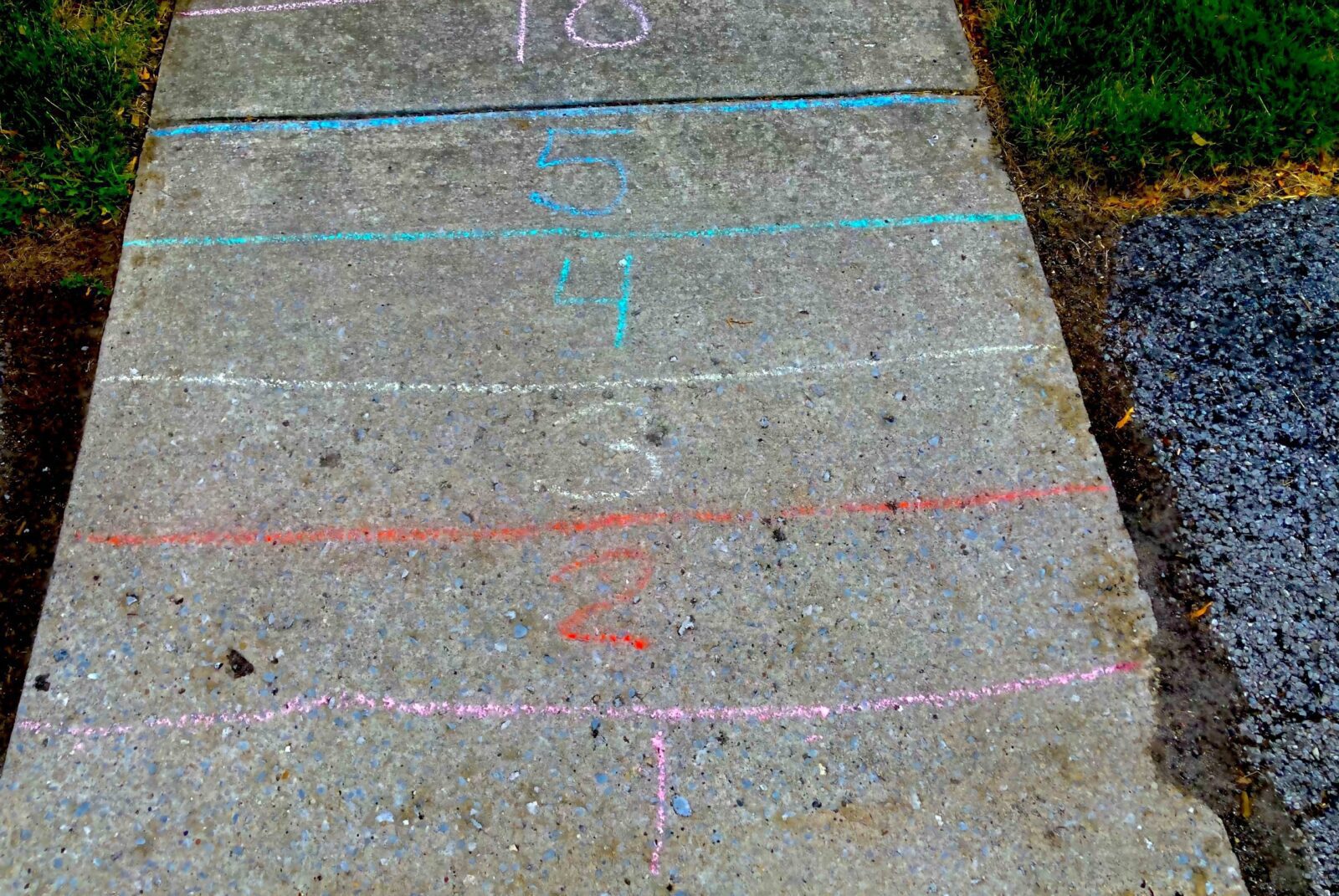
Cornhole or Bags are popular games at many summer gatherings. These are family-friendly outside activities for kids that any age can play. While playing, they develop counting skills, spatial reasoning, and measurement. You don’t even need a board with a hole in it to play. You can easily create your target with household items and play in the grass , or draw your target with chalk on the sidewalk.
Highlighting the math in Bean Bag Toss games:
- With younger or less experienced children, use a hula hoop or draw a circle with chalk on the sidewalk. Use five bags to toss towards the target. No bags? You can even use sponges or balls of socks! After the child tosses the bags, talk about how many bags are in the circle and how many are outside the circle; are the bags near the target, or are they are far away from the target? Talk about how there are still five bags, even though there are some bags inside and some bags outside the circle.
- Older or more experienced children can draw a multi-leveled target with different point values on the sidewalk and record their points.
- Play Bean Bag Toss as a carnival game by drawing a row of circles on the sidewalk or placing buckets, pots, or other types of containers in a row. As you create the row of chalk circles or buckets, you can measure to make sure there is equal distance between each one. Additionally, you can measure the length of the entire row. Start with just three spots and add on to make the row longer.
- If you are playing with chalk on the sidewalk, you can create a “scoreboard” for your child(ren) to fill in.