Cutting paper hearts for Valentine’s Day math fun is a common, early experience with symmetry for many young children. What joy to open a folded paper and discover a heart with two identical sides!
A shape has reflectional symmetry (also called line or mirror symmetry) if there is a line going through it that divides it into two halves, which are mirror images of each other. Folding a piece of paper creates this line, or axis of symmetry, and any shape cut along the fold will be reflected on the other side.
Have plenty of red paper on hand? Allowing children to explore where to fold and how to cut valentine hearts on their own leads to many discoveries. If the axis you fold at is not in the right place, the two halves aren’t identical at all.
Children are naturally curious about symmetry, so here are some more ways to explore symmetry that your children will love.
 Exploring with Mirrors
 Exploring with Mirrors
Provide children with cards showing geometric shapes, letters, and numerals and small mirrors. Allow children time to become familiar with ideas of symmetry and reflection. Then ask questions such as, “When you put the mirror there, does the shape look the same on both sides or different?” or “Can you find a place to put the mirror so you still have a letter H? or a number 3?
Exploring with Blocks
Children naturally create block designs and structures with symmetry. As they add a block to one side, they add a block to the other to maintain balance and create a pleasing harmony of shape and form. 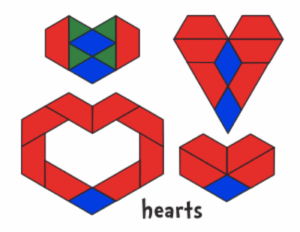 You can nurture this interest by providing photographs of famous buildings and helping children notice their symmetrical features (those of us in Chicago are partial to the John Hancock Center). Can they replicate these famous buildings in the block corner?
Adding mirrors to play with pattern blocks invites more investigations with symmetry.
Exploring with Books
For books that can extend thinking about shapes and their attributes, check out When a Line Bends… A Shape Begins by Rhonda Gowler Greene or Color Farm by Lois Ehlert. Both have a heart or two in them but include many other shapes to explore as well.
This simple interaction between caregiver and toddler is a demonstration of very early mathematical concepts, or “precursor concepts.” The caregiver assists the toddler in putting balls down tubes, eventually coming to one that doesn’t quite fit. Yes, this is working with the attribute of size. But it also creates a pattern with the balls and tubes.
We see the child and the teacher establish a pattern: the child drops the ball into the tube, hears the clunk of the ball hitting what’s below, and then looks in the tube and sees the last ball she dropped. This goes on until the large balls are introduced and the pattern is broken. The teacher is highly instrumental in establishing and reinforcing this pattern.
Long before young children are writing equations with the equal sign, they are exploring how amounts that look different can actually be equivalent.
Ideas about equivalence develop through everyday, concrete experiences that require children to find something that is the same as something else. Imagine a child figuring out how to fill a space in a block structure when the desired shape is not available (two isosceles right triangle blocks are the same as a square block) or sharing colored candies with a sibling (my 3 reds and 1 yellow are the same as your 2 reds and 2 yellows).
The following books offer engaging visual representations of equivalence—in the form of balance and equivalent representations of numbers.
-
Balancing Act by Ellen Stoll Walsh
This animal tale of mice on a seesaw is one of our favorites. Two mice, one on each side, balance just fine on the seesaw they are playing on. But when you begin to add more colorful animals to each side, you get different results.
Balance is a powerful, intuitive metaphor for equivalence. You can use a kinesthetic approach and have children extend their arms to look like a seesaw. They can act out what happens in the story as animals come and go from the seesaw. Draw children’s attention to the idea that if you have a balanced seesaw and change only one side, then the two sides are no longer equal and the seesaw will tilt. However, making the same change to both sides maintains a balance.
A pan balance scale and small animal toys is a great way for children to continue exploring this idea of equivalency.
-
Twelve Ways to Get to Eleven by Eve Merriam
This book by poet Eve Merriam introduces a perplexing problem: Where did 11 go? The story leads you to find 11 on each turn of the page, but in many different ways. For instance, out of a magician’s hat you find four banners, five rabbits, a pitcher of water, and one bouquet of flowers. As you discover many collections of 11 things, you realize that all of the 11-collections are equivalent amounts, even if they are made up of vastly different things.
Make your own class book of Many Ways to Get to X. Select a target number and have children draw or make collage pictures that represent that same number in different ways. Reinforce the idea that even though each page looks different, they all show the same number of things.
-
One is a Snail, Ten is a Crab by April Pulley Sayre
 This silly counting book tallies up the number of feet of various animals. It begins with a snail, which only has one “foot,” and then goes on to a human with two feet, a dog with four feet, and so on, up to a crab with ten feet. Larger numbers are represented in more than one way such as “40 is four crabs…or ten dogs.” The illustrations of animals playing at the beach keep the book fun and invite you to imagine many wacky combinations of animal feet.
In the primary grades, have children write their own Feet Riddles, such as
- If you have 3 crabs and 2 dogs, how many feet?
- If you put 2 insects with me, there are 20 feet. Who am I?
- There are 11 feet. There are no crabs and no humans. Who are we?
- 2 spiders’ feet are equal to a crab plus me. Who am I?
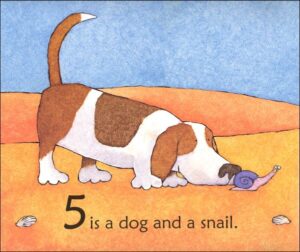
Sets are basic to children’s thinking and learning. They are also basic to our number system. One of the most important jobs of each number is to describe “how many” there are in a set of things — be it one, seven, or three hundred and nineteen. Before we can figure out how many apples there are, we have to decide which things are apples, and which are not.
All members of a household have things in common and things that set them apart. Exploring the important ways that loved ones go together and what makes them unique involves both mathematical thinking and a lot of fun.
Kick off your getting-to-know-you or family studies with the book Five Creatures by Emily Jenkins. In this story, a little girl describes the five creatures in her house—3 humans and 2 cats—by putting them together in various groups by their physical attributes, likes and dislikes, and talents.
Three with orange hair, and two with gray.
Three who like to drink milk, one who’s allergic, and one who has it only in coffee.
The myriad attributes of family members provide a meaningful context to explore the Big Ideas of Sets, namely:
- Attributes can be used to sort collections into sets.
- The same collection can be sorted in different ways.
- Sets can be compared and ordered.
Teachers can use the book to explore sets and sorting with our classroom activity People Sort.
But why stop there? After exploring in the classroom, continue the learning at home. Ask families to contribute to a Creatures in our Classroom book. This helps build a bridge between math at school and math at home, while welcoming families to share what makes them unique. Finding different sets of people (and animals) is a way to celebrate what makes us special and what makes us similar.
Resources to involve families include this video to send home with how-to instructions to make pages for the class book about their own family. Here are templates for the pages of the book so that each family can illustrate two ways to sort the “creatures” in their home. Both video and print resources are available in English and Spanish.

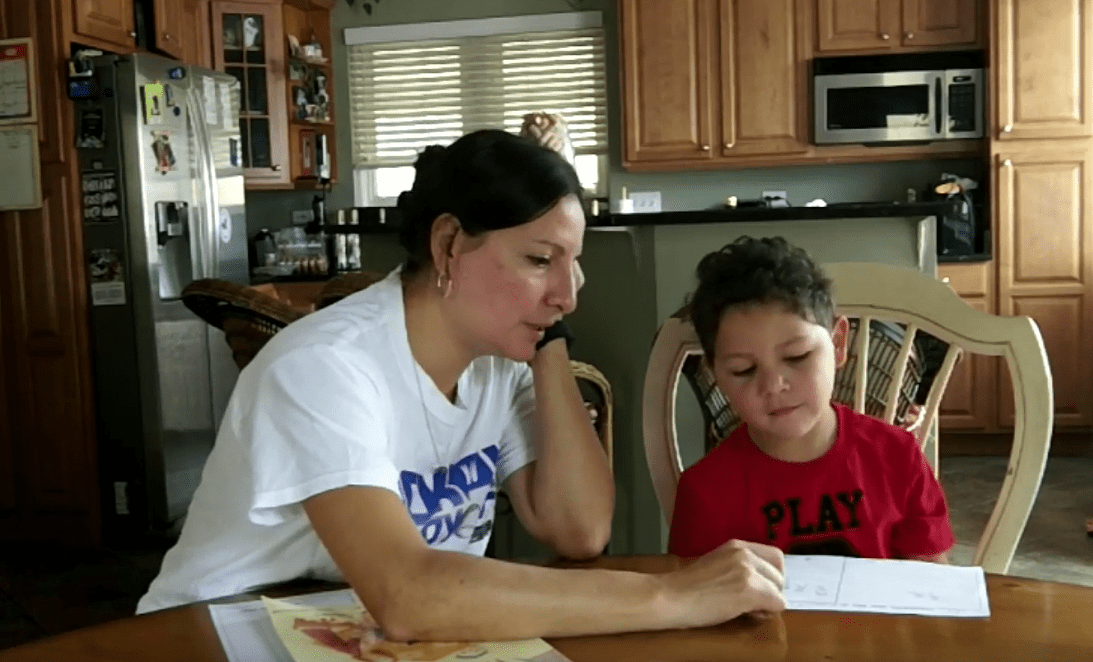
Creatures at Home Downloads
Find downloadable and printable directions and templates on the Download page Creatures at Home Activity.
From an early age, children notice and appreciate patterns in the world around them. Patterns and sequences of different kinds begin to pop up all over the place, especially in the books that children love. Pattern books for kindergarten and preschool ages can mean a lot of things, since pattern itself is a complex topic.
Many children’s books contain patterns because that supports literacy development. Children use language and picture patterns to “read” predictable books. Patterns in stories allow children to predict what will happen next. Here are some of our favorite read alouds that invite children to make use of patterns to “read” along with you.
-
Pattern Bugs by Trudy Harris
This colorful and fun picture book is full of visual and verbal patterns. Not only do you see worms crawling with every other one arching its back, creating a pattern, you will also find that same pattern in the words of the poem, such as”flutter-float, flutter-float,” and in the decorative border on the page. Have children help to find all the illustrations that share the same pattern structure (AB, ABBA, etc.) on any given page. A pattern hunt like this highlights the Big Idea that the same pattern structure can be found in different forms.
-
Brown Bear Brown Bear What Do You See? by Bill Martin Jr.
This classic book illustrated by Eric Carle is on virtually any list of great books to have in the classroom. And it has a clear pattern that young children can quickly notice, and also repeat. Teachers and parents can ask children to identify the words that repeat to help them see the regularity and rhythm in the story.
-
I Went Walking by Sue Williams
This vibrant storybook is similar to Brown Bear Brown Bear What Do You See? in some ways, but it adds some interesting complexity to a pattern story. As the red-haired boy comes across different animals on his stroll, the menagerie of creatures trail him on his walking journey. The illustrations reveal a growing pattern. Each page adds one more animal to the long line of followers.
-
The Napping House by Don and Audrey Wood
Here is one of the pattern books for kindergarten and preschool ages that we recommend often. The illustrations in The Napping House are fun and humorous and provide a great opportunity for children to identify a plus-one growing pattern. As the characters pile one by one onto the bed for a nap, each page clearly shows the growing, linear sequence and foreshadows what comes next. You can find an example of two teachers exploring this book in our Focus on the Lesson video Who is Napping?