A second-grader works on basic number combinations as we see him playing a comparison card game, Capture It. Comparing a number card to his opponent’s card, he can quickly and accurately share who has the higher number. Then the interviewer and child play with two cards each and compare sums. We see that this child is also accurate when comparing sums but is still developing his efficiency and flexibility, key indications of fluency.
For example, at one point both players have a five card. He observes that her cards make eight and his cards add to only five. He does not notice the fives “cancel each other out.” Although in the video we can observe how much he knows about counting, he is still developing the ability to reason about number relationships.
Focus on the Child videos are taken from one-on-one interviews with individual children. The interviews are designed to elicit evidence of children’s mathematical thinking. They are not teaching episodes or formal assessments.
The math story this second grader solves is a change unknown story. There was a full carton of a dozen eggs but when the interviewer goes to make her breakfast there are only three eggs left. She wants to know how many were eaten before she got to the eggs. First he answers one egg. She retells him the story with more details to connect to prior knowledge about egg cartons. He seems to understand the story better. The next time he counts up from the number he knows using his fingers as tools to arrive at the correct answer.
Focus on the Child videos are taken from one-on-one interviews with individual children. The interviews are designed to elicit evidence of children’s mathematical thinking. They are not teaching episodes or formal assessments.
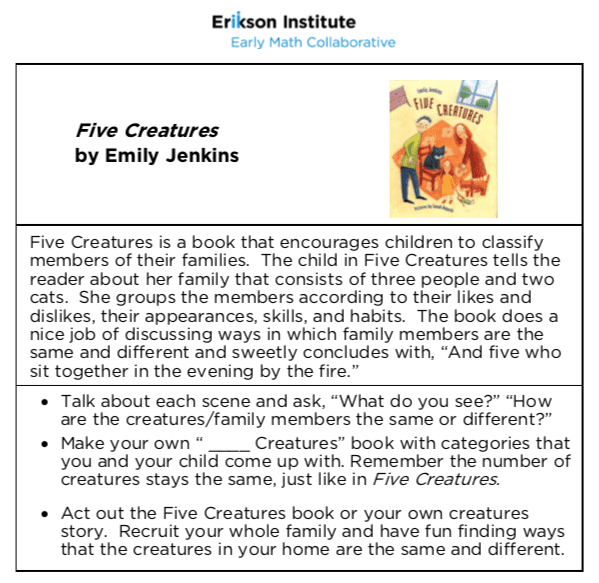
Five Creatures
This book by Emily Jenkins includes three humans and two cats in one house. That allows a lot of opportunities for sorting! This printable activity card in both English and Spanish invites home explorations with sets and sorting using the book. You can watch and read further about an example activity here in our Ideas at Work series: All Sorts of Families: Connecting School and Home with Math.

A Pair of Socks
By Stuart J. Murphy, this book uses illustrations and language to highlight qualities a sock could have. This downloadable activity card provides fun activities at home while developing children’s recognition of attributes as well as deepen their matching abilities when dealing with sets and sorting of objects.
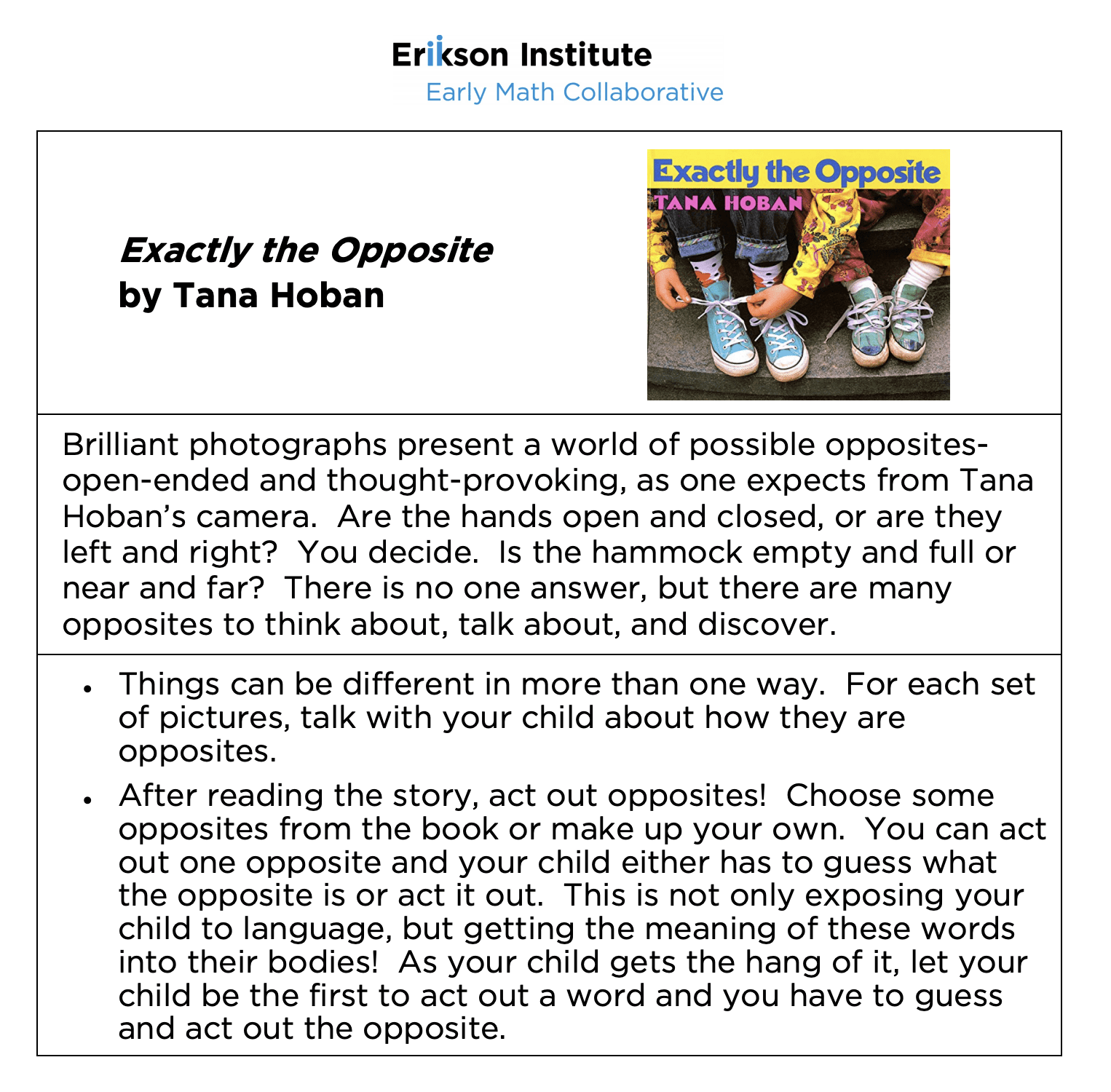
Exactly the Opposite
This book by Tana Hoban contains photos that inspire conversation, showing two items that are opposites in some interesting way. This printable Spanish and English activity card can accompany parents for opportunities to engage children at home.
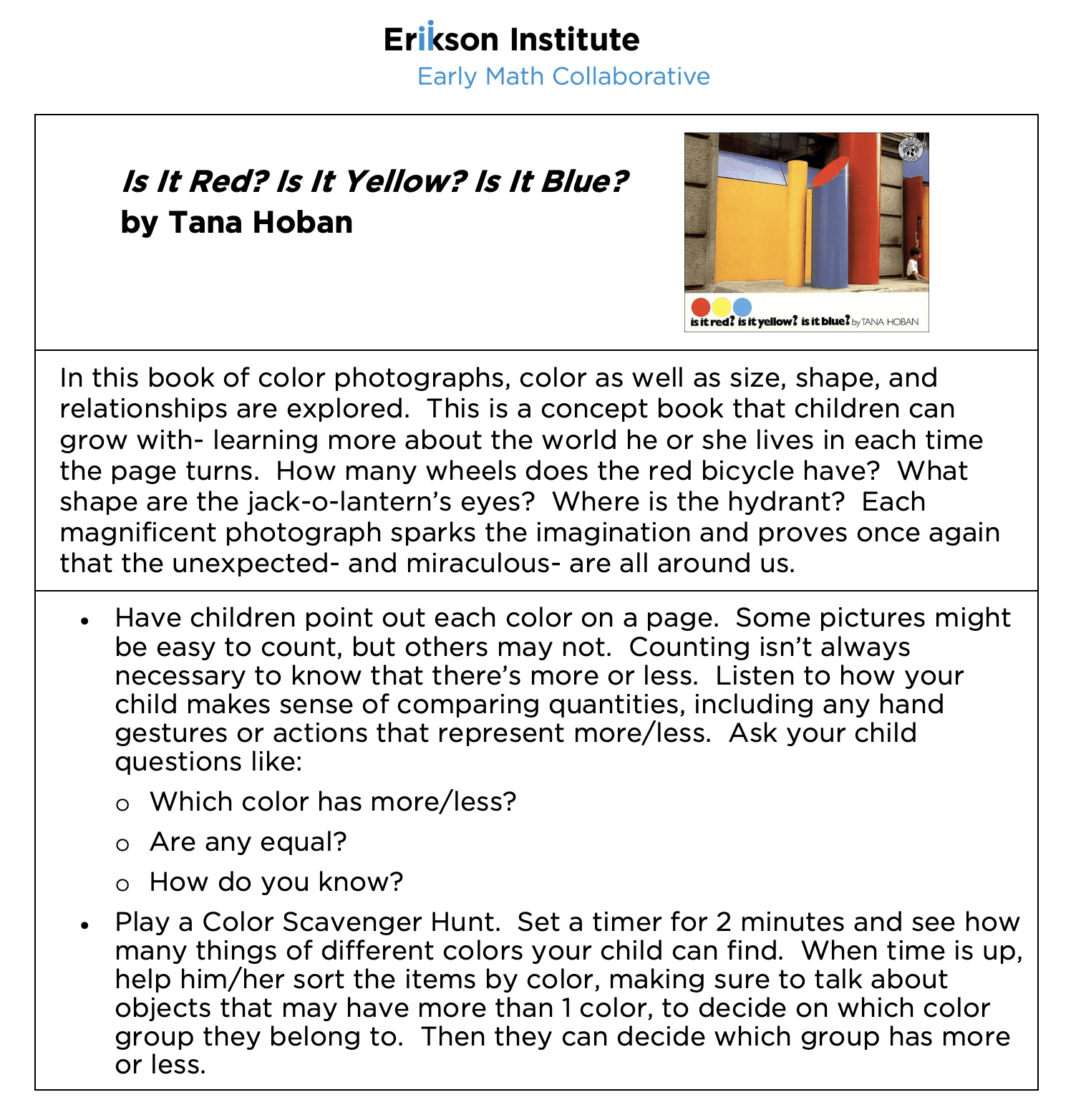
Is it Red? Is it Yellow? Is it Blue?
This wordless book encourages conversations about an engaging attribute, color, while also inspiring questions about what is happening from page to page. This printable activity card can take the discussion to the at-home setting.
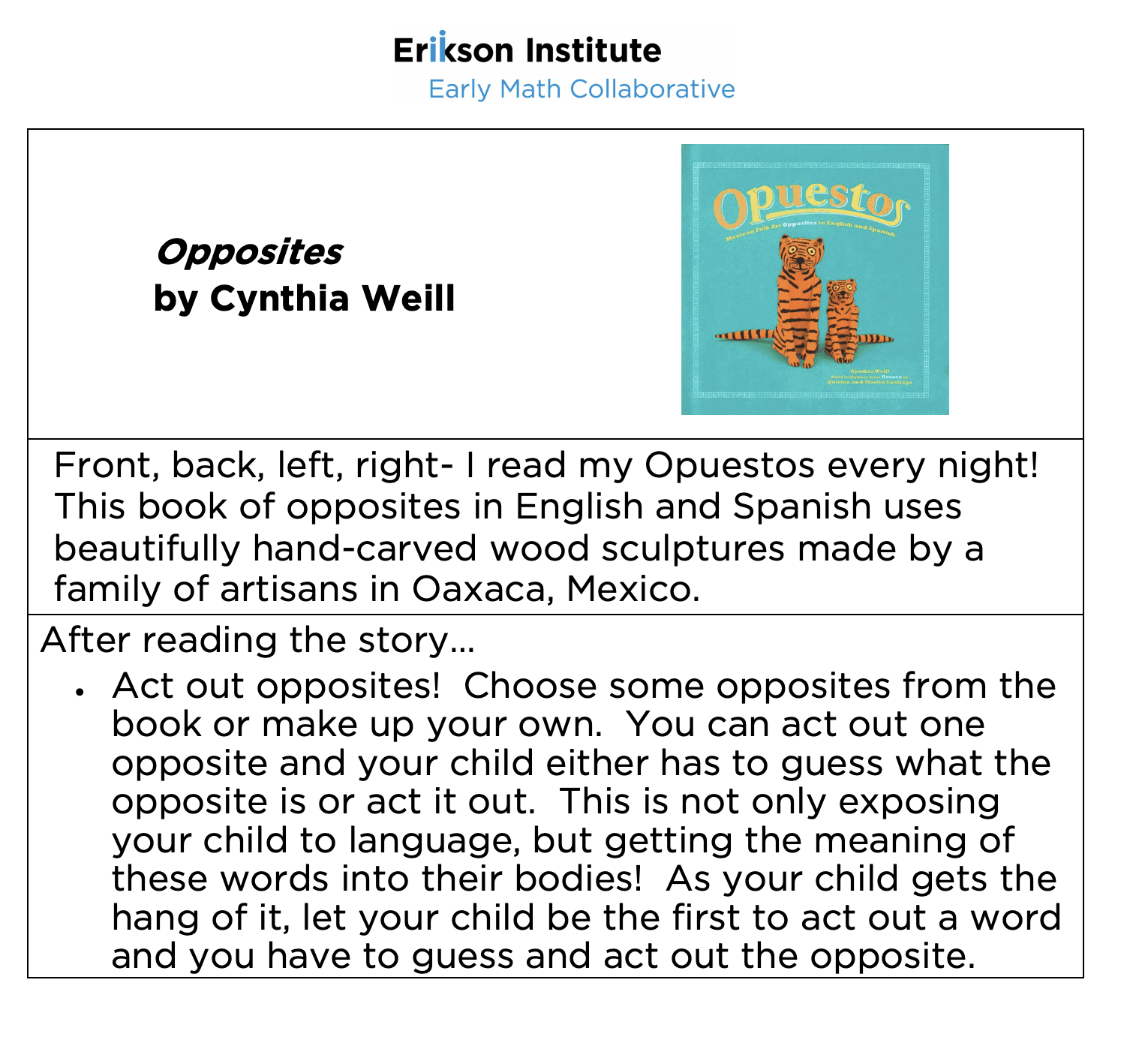
Opuestos/Opposites
By Cynthia Weill, this book is in Spanish and English and is great for discussions around sets and sorting. Explorations of different cultures intermixed with important early math concepts can still provide fun activities at home. This activity card can go home with parents to further the math thinking in more settings beyond the school or library.
Browse all ourdownloads
You’re logged in! That means you have access to a lot more downloadable early math ideas.
View more sets content on our website: Sets.
Sorting things into categories is one of the ways we make sense of the world around us. Sorting items into groups by specific attributes gives children the opportunity to define sets according to a rule of what does and does not belong together. Sets are basic to children’s thinking and learning. And they are basic to our number system.
Additional Resources:
Preschooler Sorting Rocks (video)
Setting Up a Sorting Station (handout)
A good sense of the number ten is critical for building young children’s reasoning strategies. Decomposing 10 into pairs in more than one way is a core activity in kindergarten. Here we see kindergarteners making the number ten on a rekenrek number rack, a tool with red and white beads in groups of 5s with 10 beads on each row. The rekenreks have two rows of beads, so the teacher uses the context of a double-decker bus so that children imagine the beads to represent people riding on the top and bottom levels of the bus.
First, children find many ways to make 10. Then the teacher challenges them to find the number that makes 10 when added to a given number. Knowing how any number from 1 to 9 relates to the benchmarks of 5 and 10 is foundational for building fluency in the early grades.
Want to give this lesson a try? Here are simple instructions to make your own rekenreks like you see in the video. Also visit the Math Learning Center to download their free PDF booklets for introducing and using a rekenrek number rack. Their free Number Rack app is a great digital tool for class demonstrations and online learning.
A kindergartner uses blocks to make groups that are larger than, smaller than, and equal to the instructor’s set, attempting to think central math concepts through.
Focus on the Child videos are taken from one-on-one interviews with individual children. The interviews are designed to elicit evidence of children’s mathematical thinking. They are not teaching episodes or formal assessments.