Big Feelings in Little Bodies
By Mariana Souto-Manning, PhD, President, Erikson Institute
At a Glance
A four-year-old receives the wrong-colored cup and collapses as though the family has suffered a major constitutional crisis.
A toddler screams because the banana broke.
A child cries at school drop-off, even though yesterday’s drop-off went smoothly and everyone had declared the transition “solved.”
Adults often look at the size of the event and compare it with the size of the feeling. The cup is only a cup. The banana remains edible. The parent is coming back. From an adult perspective, the reaction can seem wildly disproportionate.
But feelings do not arrive with a ruler.
Young children experience emotion through developing brains and bodies. They do not yet have reliable access to the skills adults use—on our better days—to name a feeling, understand its cause, imagine its ending, slow an impulse, or choose an effective response. A small disappointment can flood a small body. The child is not giving us a performance review of our caregiving. The child is having a hard time.
Emotion Is Not Misbehavior
This does not mean every behavior is acceptable. A child may be angry; the child may not hit. A child may be disappointed; the child may not destroy another person’s work. A child may resist leaving; the adult still has to get everyone home.
The distinction matters: feelings are allowed, and behavior has limits.
When adults confuse emotion with misconduct, we may try to discipline the feeling itself. “Stop crying.” “You are fine.” “That is nothing to be upset about.” “Big kids do not act like this.” These phrases often come from our own discomfort. We want the distress to end. We may also be repeating what adults said to us.
Yet dismissing a feeling does not teach regulation. It teaches concealment. A child may become quieter without becoming calmer. The nervous system has not learned what to do; it has learned what not to show.
The American Academy of Pediatrics’ work on early relational health emphasizes safe, stable, nurturing relationships as foundations for healthy development. Young children develop regulation through co-regulation: the repeated experience of being helped by a steadier adult.
Co-regulation does not require saintly serenity. It asks the adult to become the less dysregulated person in the interaction.
Fewer Words, More Steadiness
During an emotional storm, long explanations rarely help. The child’s brain is not available for a lecture on gratitude, fruit, or family values.
Try fewer words:
- “You wanted it whole.”
- “You are really disappointed.”
- “I will not let you hit.”
- “I am staying close.”
- “When your body is calmer, we will decide what to do.”
This language does several things at once. It recognizes the child’s experience, protects safety, and communicates that the relationship remains available. The adult is not surrendering the limit. The adult is refusing to make belonging conditional on emotional convenience.
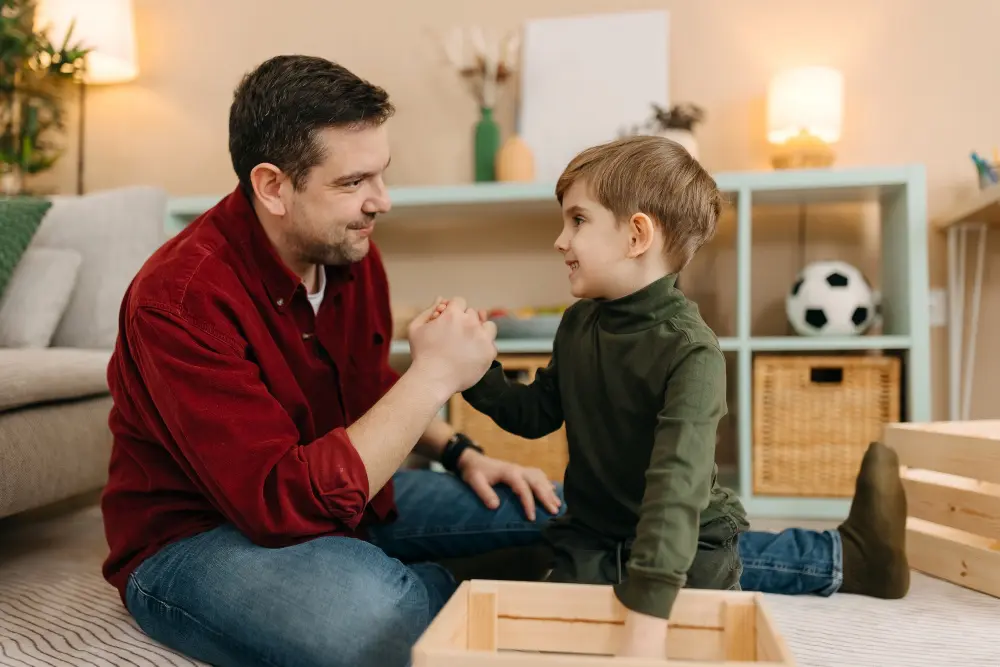
After the child is calm, teaching can begin. “You were angry when the game ended. You threw the cards. Cards are not for throwing. Next time you can say, ‘I need a break.’ Let’s pick them up together.” This is discipline in its most useful sense: teaching a skill, naming impact, and practicing repair.
Whose Feelings Are Considered Too Big?
We also need to ask whether adults interpret children’s emotions equitably. Research and practice have repeatedly shown that adult perceptions are shaped by race, gender, disability, language, culture, and expectations. The same energetic behavior may be called leadership in one child and defiance in another. The same tears may be viewed as sensitivity in one child and manipulation in another.
A children’s-rights approach requires us to examine not only the child’s behavior, but our interpretation of it. Who receives comfort? Who receives punishment? Who is granted complexity? Who is expected to regulate without support?
At Erikson Institute, reflective practice is central to how we prepare professionals. Reflection is not simply thinking about what happened. It is noticing what the moment activated in us. Why did this child’s refusal feel disrespectful? What story did I tell myself about the parent? Did I read distress as danger because of who the child is? What support do I need so that my own nervous system does not become the child’s burden?
This is not an argument for adults to accept harm or exhaustion without help. Co-regulation depends on supported caregivers and educators. A chronically overwhelmed adult cannot be endlessly available by force of will. Children’s emotional rights are connected to working conditions, mental health supports, manageable group sizes, family leave, and community care. We cannot preach calm to adults while designing systems that keep them in crisis.
Big Feelings Need Room, Not Rule
Children’s emotions carry information. Fear may signal that something feels unsafe. Anger may signal a blocked goal or perceived injustice. Grief may return in waves. Excitement can overwhelm the body just as sadness can. Some children experience sensory input intensely. Some need movement, quiet, repetition, or more time to transition. Every behavior has a backstory.

Our task is not to let emotion rule the room. It is to make room for emotion while the adult holds the boundary.
- “You can be furious. The answer is still no.”
- “You can miss your parent. I will help you through the goodbye.”
- “You can cry. You are not alone.”
A child does not become emotionally strong by being told that feelings are weakness. Emotional strength grows when children experience feelings as survivable, nameable, and held within relationships that do not disappear when life becomes loud.
Big feelings in little bodies are not interruptions to development. They are development underway. When we meet them with steadiness, boundaries, humility, and care, we teach children something larger than how to calm down. We teach them that their inner lives matter—and that having a hard moment never makes them less worthy of dignity.
Erikson Resources, References, and Further Reading
• “Infant and Early Childhood Mental Health Certificate.” Professional preparation focused on infants’ and young children’s social, emotional, and relational development.
• “Infant and Early Childhood Mental Health Concentration.” Erikson’s developmentally informed, relationship-centered MSW concentration.
• “Parents and Caregivers Are Essential to Infant and Early Childhood Mental Health.”
• “Strengthening Support for Infant and Early Childhood Mental Health.” A holistic discussion of children, caregivers, family strengths, community context, and professional support.
• “Supporting Young Children’s Social-Emotional Development in Early Intervention.”
Other Research and Rights Sources
• Center on the Developing Child at Harvard University. “Young Children Develop in an Environment of Relationships.”
Join the Erikson family with monthly news + events updates shared by academics, community members, and families.

Create a Better Future For Children While Building Yours
Embark on your early childhood graduate program path at Erikson Institute and start changing lives.