Where Mathematics Begins: The Story Behind Math All Around Me
It was a simple statement, but it began a trajectory of a decade of work. When Barbara Abel shared those words with Mary Hynes-Berry and Jie-Qi Chen, the three had already spent years helping preschool educators at Educare deepen children’s mathematical thinking through professional learning experiences with Erikson Institute’s Early Math Collaborative.
But Barbara, whose expertise is infant and toddler development, saw something more.
She recognized ideas and thinking she knew to be present in infant and toddler development reflected inside the concepts of the Big Ideas for preschool.
Her statement sparked a journey that ultimately became Math All Around Me (MAAM), inviting early childhood professionals to see mathematics where it has often been overlooked: in the everyday experiences of infants and toddlers.
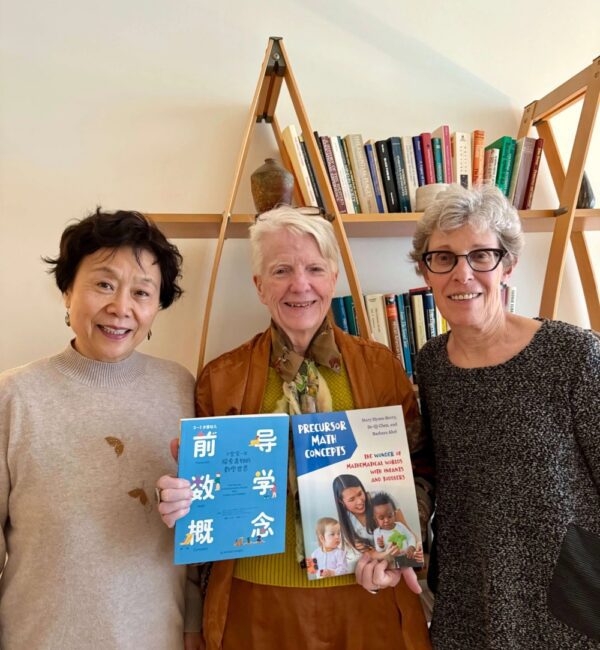
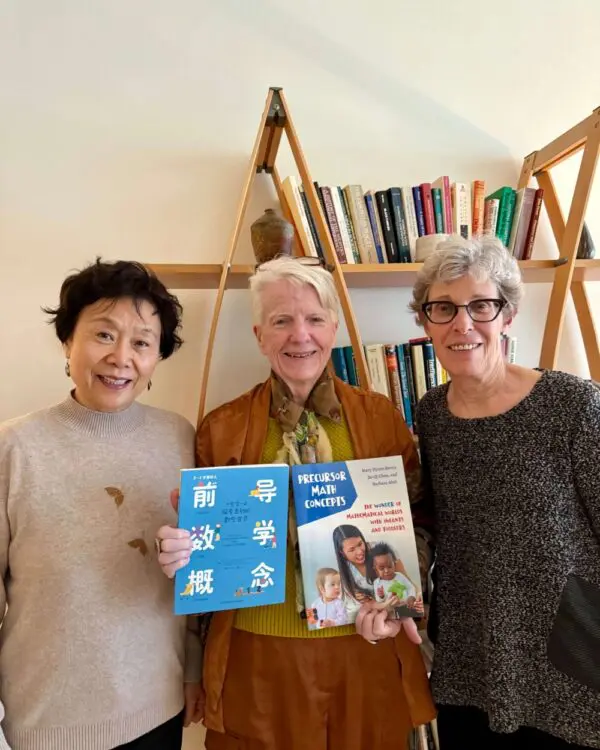
As the MAAM companion book, Precursor Math Concepts, approaches its fifth anniversary, and the project itself celebrates a decade since its launch, we sat down with the three “founding mothers” to reflect on how the work began, what they discovered along the way, and why they believe its central message is more relevant today than ever.
The Moment Everything Changed
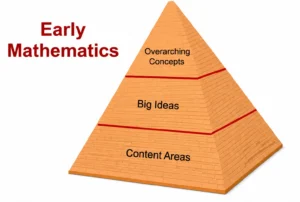
The Early Math Collaborative had long focused on supporting educators working with preschool-aged children. Each year, educators explored the interconnected “big ideas” of mathematics culminating in a framework that illustrated how these concepts fit together.
During one of those sessions, Barbara saw something familiar in an image conceptualizing preschool mathematics. She recalls turning to a colleague and saying, “Turn it over and that is infancy,” and the realization clicked into place, “We know where this begins.”
The team knew they did not want to just create methods for how to teach younger children the mathematics of preschool. Instead they began asking a different question: What kinds of thinking make later mathematical understanding possible? The answer required looking beyond what is traditionally thought of as “math,” counting, shapes, and number words. It meant examining how infants and toddlers make sense of their world from birth.
Through this exploration, the team identified four Precursor Math Concepts, attributes, comparison, change, and pattern, that describe foundational ways of thinking children develop through everyday experiences. These concepts are not mathematics in the traditional sense. They are cognitive building blocks that prepare children for later mathematical reasoning.
Discovering Mathematics in Everyday Life
Throughout our conversation, the authors kept returning to the idea that mathematics is a way of thinking. “When people hear the word math,” Jie-Qi explained, “they immediately think about numbers.” But long before children count, they notice that milk is warm or cold. They compare familiar and unfamiliar faces. They anticipate routines. They recognize patterns in songs, movement, and daily caregiving experiences. Barbara describes this as a “way of taking in the world that comes before – that lends itself to future mathematical thinking.”
These moments may not look like mathematics, but they are the beginnings of the logical thinking that mathematics requires. For the MAAM team, this represented a significant shift in perspective. Rather than asking, “How do we teach math to infants and toddlers”, they began asking, “How do we recognize the mathematical thinking that is already developing?” That subtle change transformed both the professional learning and the role of the educator.
Putting the “Collaborative” in Early Math Collaborative
The team recalled countless hours of discussion, debate, questioning, and reflection. Ideas were tested, definitions were changed, and concepts evolved. Often, they left sessions with more questions than answers. Sometimes they disagreed. “We weren’t having arguments,” Mary reflected. “We were having conversations.” She described conversation by returning to its Latin roots, a “turning with” one another rather than talking at one another.
Those conversations extended beyond the project team. Throughout the pilot, funded by The Pritzker Foundation and CME Group Foundation, infant and toddler educators became collaborators in the learning process. The creators carefully listened to participants’ observations, questions, and experiences. More than once, they returned to sessions having revised ideas because teachers had helped them see something they had missed. That willingness to learn alongside practitioners became one of MAAM’s defining characteristics. As Jie-Qi noted, the educators were not simply watching experts teach. “We were learning from them too.”
Throughout our conversation, the authors repeatedly described how this new perspective has the power to reframe familiar experiences. A newborn turning toward the scent of a mother’s milk became a moment that involved attributes and comparison. A caregiver noticing a child’s response to an unexpected change in routine illustrated awareness of pattern. These were not new behaviors – they were newly recognized as mathematical.
Mary illustrated this shift in perspective by sharing a story about teachers observing a video of toddlers engaged in a fingerplay, saying, “if you looked at that video, you wouldn’t necessarily think there was anything mathematical about it, but by looking at it and asking questions, wondering, it became just this incredibly powerful indication of how precursor concepts work and how everything is related.”
Barbara described the process as, “We kept seeing things in new ways.” That widening perspective became one of MAAM’s greatest contributions. Instead of adding more activities to already busy classrooms, MAAM helps educators recognize and take advantage of the thinking and learning already taking place.
CAIR: The Heart of Math All Around Me
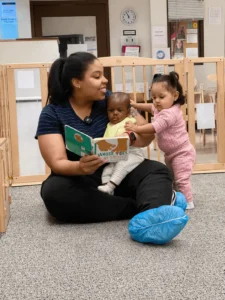
As the conversation unfolded, the discussion shifted from mathematical concepts to relationships. Repeatedly, the creators returned to what eventually became the CAIR Principle: Closely Attend. Intentionally Respond.
The team sees CAIR not as an instructional strategy, but a philosophy of teaching: Closely attending means observing children carefully enough to understand what they are noticing, wondering, and trying to communicate. Intentionally responding means building on those observations in thoughtful, individualized ways.
For Mary, not only is CAIR the heart of interacting with young children, it encourages a shift away from deficit thinking. Research can tell us about general developmental patterns, she explained, but it cannot tell us what this child is thinking in this moment. That requires careful observation. Every child brings unique strengths, interests, and ways of understanding the world. Additionally, Barbara’s expertise in infant and toddler development was critical in recognizing the many ways that our youngest learners communicate in addition to vocalizations and language, such as eye gaze and body language.
The Impact of a Decade of MAAM
One of the most meaningful outcomes of MAAM has been educators’ response. Professional Learning facilitators at the Early Math Collaborative, who are continuing the work share that participants experience a profound shift during the MAAM Learning Lab series. Many educators initially expect another list of standards or additional lessons to squeeze into already full days. Instead, they discover something unexpected: They are already doing the work: changing diapers, preparing bottles, serving meals, playing pat-a-cake, comforting children, reading books, and watching children explore. The difference is not adding more. It is bringing new intentionality to what already happens throughout the day. For the MAAM team, these are the moments that matter most. Not elaborate activities or expensive materials. Simply seeing children’s thinking more clearly and responding to that thinking with intention.
Looking Ahead
Jie-Qi, Mary, and Barbara all expressed gratitude for the opportunity to come together and reflect on their journey, reflecting on their collaboration and sharing, “We couldn’t have done it without each other.” As the conversation drew to a close, thoughts turned toward the future. Mary expressed hope that people would recognize infants as naturally intelligent learners whose curiosity deserves careful attention. Barbara hopes future researchers will continue exploring and testing the conceptual foundations the team established. Jie-Qi hopes the field continues broadening its definition of mathematics itself.
One word captured all three perspectives. Wonderstanding. Introduced in the book’s preface, the term reflects the belief that understanding begins with wonder. Young children naturally approach the world with curiosity. They come innately wired to compare, notice, predict, and explore. The responsibility of educators is not simply to provide answers but to nurture that wondering. At a time when educational conversations increasingly focus on technology and artificial intelligence, the MAAM creators believe something even more fundamental deserves attention: relationships, trust, and responsive interactions.
These are the conditions in which mathematical thinking, and all learning, begins. Ten years after the project first took shape, MAAM continues to challenge assumptions about where mathematics starts and what it looks like. Its central message remains remarkably simple: Mathematics begins at birth.
It begins with relationships.
It begins with noticing.
It begins with everyday life.
And perhaps most importantly, it begins with wonder.
Learn More About MAAM
Learn how the Precursor Math Concepts and the CAIR Principle help educators recognize and nurture mathematical thinking from birth.
Read the Precursor Math Concepts Book
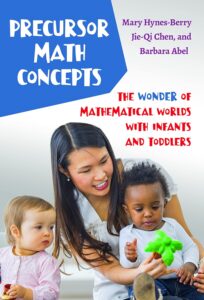
This groundbreaking book looks at the development of mathematical thinking in infants and toddlers, when mathematical thinking and problem solving first emerge as natural instincts. Each user-friendly chapter includes suggestions for highly effective practices that are embedded into everyday interactions and routines.
Math All Around Me Professional Learning Lab Series – Fall 2026
Join educators from around the world in exploring how mathematics unfolds through everyday interactions with infants and toddlers.
Join the Erikson family with monthly news + events updates shared by academics, community members, and families.
Create a Better Future For Children While Building Yours
Embark on your early childhood graduate program path at Erikson Institute and start changing lives.